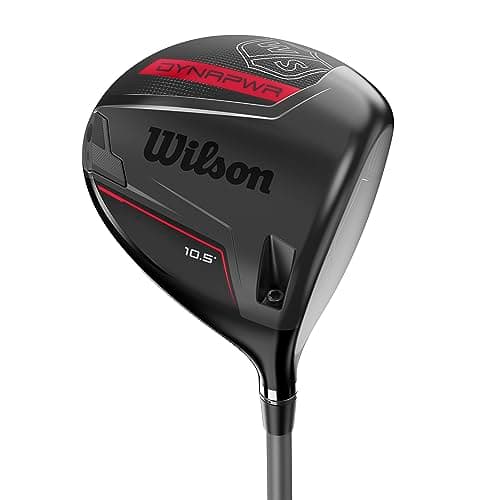
The Wilson Dynapower is the current high-launch driver in Wilson’s line, and the single most important thing to know about this listing is the number stamped on the sole: 13°. That is the most loft Wilson builds into the Dynapower, and it decides who this driver is for. Thirteen degrees is not a neutral, one-size-fits-all setting — it is a driver tuned to get the ball airborne for a swing that struggles to launch it. Read the spec honestly and it is a lot of forgiving, current major-brand driver for the money. Read it wrong — hand it to a fast swinger — and it is the wrong club on the shelf.
What it is
It is a rear-weighted, high-MOI driver head from Wilson’s Dynapower family, and this particular listing is the standard model — not the draw-biased Dynapower Max — in 13° loft with a Regular-flex graphite shaft. Wilson builds the Dynapower around two ideas they publish plainly. The first is a rear-weighted chassis that raises the head’s moment of inertia — its resistance to twisting on strikes that miss the center — so a heel or toe hit holds its line and keeps more of its speed. The second is an AI-designed, variable-thickness face, a pattern of different face thicknesses meant to protect ball speed across the whole hitting area rather than only the middle. Put those together and Wilson’s pitch is a genuinely forgiving head that flatters a mishit. What this listing is not is a draw-biased or offset driver: the standard Dynapower is a neutral-flighted head, so it adds height, not a built-in cure for a slice. Every number here is Wilson’s own published spec, not something we measured — we do not have a lab, and the way we actually score clubs is set out in how we rank.
Where it shines
The reason to buy this exact listing is launch. Thirteen degrees is the most loft in the range, and for a moderate or slower swing, height is where carry distance actually comes from. If your drives leak out low and run along the ground, if you have to swing out of your shoes to get the ball in the air, or if your natural angle of attack is steep and strips the loft off a lower-lofted head, a 13° driver is the honest fix. It gets the ball up on a higher, softer-landing trajectory without asking you to change your swing, and for the golfer this loft is aimed at, that alone is worth more than any marketing claim about ball speed.
That launch advantage is the specific thing this listing brings that the other forgiving drivers may not. Plenty of game-improvement heads are stable and roomy; fewer are offered in a loft this high. If your problem is not dispersion but simply height— the ball coming off too low, refusing to carry, and running out on landing — then more loft is the direct fix, and 13° is about as much as any driver on the shelf gives you. It is the reason to reach for this one over a standard 10.5° head even when both are forgiving.
Forgiveness is the second thing it does well, and it matters just as much for the developing swing this driver suits. The rear-weighted, high-MOI head is built to resist twisting on the off-center strikes a new or slower swing actually makes, so the mishits stay closer to your line and lose less speed than they would off a smaller, less stable head. The AI-designed variable-thickness face is Wilson’s answer to the thin-strike problem — the stated aim is to hold ball speed across more of the face, so the toe and heel drives give up less distance. It is a head that reviewers have consistently found flatters a mishit, and forgiveness on the strikes you miss is the single most useful thing a driver can give an improving golfer.
The last thing in its favor is the least glamorous: it is a lot of current major-brand driver for the money. The Dynapower usually undercuts the premium game-improvement heads while giving up very little in forgiveness or launch, which makes it one of the sensible-value picks in our best golf drivers for beginners roundup. If you want a real, current-generation driver from a brand with fitting support and resale value, and you do not want to pay flagship money for it, this is a genuinely smart place to land.
It is worth saying what the head is like to stand behind, too. A rear-weighted, high-MOI driver of this size sits large and confidence-inspiring at address, and the deep, back-heavy shape is a visual cue that the club wants to help you get the ball up — exactly the reassurance a golfer who struggles to launch it wants over the ball. It is a genuine current-generation gamer, not a decade-old design dumped on clearance, so you get a modern face and modern weighting, from a brand with fitting support behind it, at a price that usually sits below the flagship names.
Where it falls short
Be honest about the flip side of all that loft: 13° is a specific spec, not a universal one. The same height that rescues a slow swing will hurt a fast one. Feed real clubhead speed into a 13° head and you will balloon it — the ball climbs too high, spins up, and gives away distance to the wind and to a lower-lofted driver. If you already flight the ball high, or you swing it hard, this is the wrong number on the shelf even though the head itself is a good one. A faster swinger wants a lower loft and a stiffer profile, full stop.
This listing is also the Regular-flex build, and that is the flex you get. A Regular shaft suits a moderate swing; a genuinely fast player wants stiff, and a very smooth or slow tempo may want more help still. Match the flex to your speed rather than hoping to grow into it or out of it — buying the driver that already fits your swing beats compromising on the one in front of you.
The third honest limit is the one the name hides. This is the standard Dynapower, not the draw-biased Dynapower Max, so it will not straighten a slice the way an offset, draw-biased head does. If your miss is a ball that starts straight and curves hard to the right, a neutral 13° head adds height to that slice rather than taking the sideways spin out of it. The golfer who leaks it right is better served by a draw-biased, anti-slice driver — the Wilson DYNAPWR Max Lite or the offset Pinemeadow PGX in our driver roundupare built for exactly that miss. And like any big, forgiving game-improvement head, this one is designed to go straight, not to be worked left and right on command — a feature for most golfers, a limitation for the few who shape shots on purpose.
Feel is the last honest caveat, and it is a mild one. A big, forgiving, rear-weighted head is tuned for stability rather than a soft, connected strike, so the Dynapower feels solid and dependable rather than premium — you are not buying it for the sensation at impact. And because this is a fixed 13°, Regular-flex build, what you see is what you play: choose the spec that fits the swing you have now rather than one you hope to grow into. For the golfer this driver is aimed at, none of that is a dealbreaker; it is simply the honest edge of a value-minded, forgiveness-first head.
Who should buy it
The golfer this driver is built for is the one with a moderate-to-slower swing who struggles to get the ball in the air. If your drives fly low and run out, if your swing speed is modest, or if you simply want the easiest launch and the most forgiveness you can buy from a real brand without paying flagship money, this 13° Dynapower is a very sensible pick — and it is a value option in our beginner driver roundup for precisely that reason. It also suits the improving player who already flights the ball reasonably straight and just wants more height and a bigger margin for error, provided a Regular flex matches their speed. If that is you, this is a lot of driver for the outlay, and one you can hand to a beginner or a returning golfer confident that the club is helping them rather than fighting them.
Who should skip it
Three golfers should look elsewhere. The fast swinger is the first and most important: 13° and a Regular flex will balloon a quick, aggressive swing, so you want a lower loft and a stiffer shaft — read the spec twice before you buy. The slicer is the second: this neutral head adds height, not slice correction, so if your miss curves hard right you want the draw-biased DYNAPWR Max Lite or Pinemeadowinstead. The shot-shaper is the third: a forgiving, high-MOI head is designed to fly straight, and the player who works the ball on purpose will find it stubborn. Everyone in between — the slower, higher-launch-seeking swing this loft was made for — is exactly who Wilson built it for. And before you buy on hype, a launch monitorwill tell you whether 13° is your number.