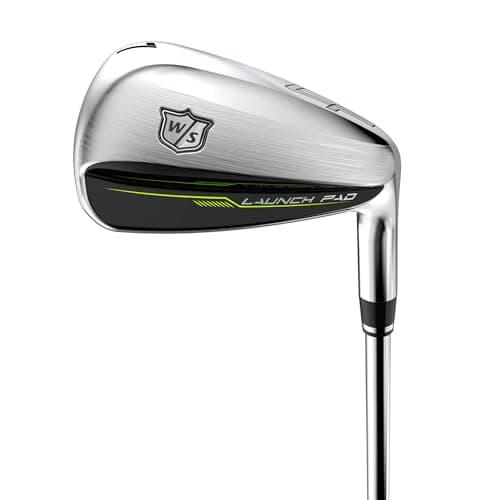
The Wilson Launch Pad 2 irons are built for one job and built for it hard: getting the ball in the air and forgiving everything, for a golfer who struggles to do either. This is a super-game-improvement set — the most forgiving, easiest-launching class of iron there is — and this listing is the men’s graphite build running from the 5-iron through pitching wedge, plus a gap wedge. If you top your long irons, if you cannot get them airborne, or if a slice is leaking shots right, this set is designed to fix exactly that. If you already flush your irons, it is the wrong set, and we will be honest about both ends.
What it is
It is a super-game-improvement iron set from Wilson, and this listing is the men’s, graphite-shafted build covering the 5-iron to pitching wedge with a gap wedge added — a sensible, gap-free scoring spread for a developing player. Wilson builds the Launch Pad 2 around a hollow-body, high-launch design: the heads are oversized and the construction is aimed at getting the ball up easily and forgiving off-center strikes across the face. The set is draw-biased, meaning the design leans the ball left to counter the slice most higher handicaps fight, and the light graphite shafts help a slower or smoother swing find clubhead speed. Put simply, Wilson’s pitch is maximum height, maximum forgiveness, minimum fuss. Every design claim here is Wilson’s own published wording, not a lab result of ours; how we actually score clubs is set out in how we rank.
Where it shines
Launch is the whole reason this set exists, and it is where it delivers. The hollow-body, oversized heads are designed to get the ball up for players who cannot launch a normal iron — the golfer whose mid and long irons fly low, run out and never hold a green. If that is your miss, the Launch Pad turns those clubs into something you can actually use, on a higher trajectory that lands softer. For a beginner or a slower swing, that easy height is the difference between an iron that works and one that just embarrasses you, and it is the single most valuable thing this set offers.
Forgiveness is the second strength, and it runs across the whole face. These are super-game-improvement heads, so the weighting is built to keep mishits going somewhere useful — a strike off the toe or heel loses less distance and stays straighter than it would off a more compact iron. Combined with the light graphite shafts and the draw bias, the effect is a set that flatters exactly the swing a developing player brings: it fights the slice, it forgives the off-center hit, and it does not demand a repeatable, center-face strike to give you a playable result.
The third thing worth crediting is the honest fit of this specific build. Graphite shafts suit the slower or smoother swings this set is aimed at, and the 5-iron-through-gap-wedge spread is a sensible, gap-free range for a beginner — you are not left with a hard-to-hit 4-iron or a hole in your scoring distances. It is a set designed to be picked up and played, which is exactly what its buyer wants. It sits alongside the more compact game-improvement sets in our best golf irons for beginners roundup.
There is real distance here too, and it is worth understanding where it comes from. Like most super-game-improvement sets, the Launch Pad 2 is built with strong lofts and a hot, high-launching face, so the ball comes off fast and carries — a 7-iron here may fly what you think of as a 6-iron distance. That is not free yardage so much as the number on the sole moving; the flight is high and soft because the head is designed to launch it, not because you suddenly swing faster. For the buyer this set is for that is a genuine benefit, because more carry and a higher landing angle mean the ball actually holds the green — just do not compare it club-number to club-number against a traditional set, and do gap your wedges with the stronger lofts in mind.
Where it falls short
The honest trade a super-game-improvement iron makes is control and feedback. All the forgiveness that helps a struggling ball-striker comes from a big, offset, strong-lofted head that does not shape shots and does not tell your hands much about the strike. A better player who wants to flight the ball down, work it left and right, or feel exactly where they caught it will find these irons muted and hard to control — the feedback that helps you improve is deliberately damped. For the golfer this set is for, that is a fair trade; for a good ball-striker it is the wrong set entirely.
The strong lofts and draw bias have a second cost: a hot, sometimes unpredictable long-iron flight. Strong lofts chase distance, but in the longest irons of a super-game-improvement set they can produce a ball that flies lower and runs more than you expect, and the built-in draw can turn into a genuine hook for a player who does not slice. If your miss is already a pull or a hook, the draw bias works against you rather than for you.
They also look and feel like what they are. Super-game-improvement irons have big, offset, thick-topline heads, and a better player will find them bulky behind the ball; the graphite shafts and soft, hollow-body construction give a muted, “clicky” feel that tells your hands very little about the strike. For the golfer who needs help that is a fair, even welcome trade — the feedback a blade gives is punishment they do not need — but if you have started to strike your irons well, that same muffling is the thing you will grow out of first.
One practical point, too: even in a set this forgiving, the longest irons are still the hardest clubs to hit. Many golfers who buy a super-game-improvement set are better off replacing the 5 or even the 6 iron with a hybrid, which launches higher and lands softer still — the easy-launch heads in our best golf hybrids roundup are built for exactly that gap, and a hybrid-iron combo is a common, sensible way to set up a bag like this.
The set makeup, and what to pair it with
This listing runs from the 5-iron through the pitching wedge with a gap wedge added, which is a sensible, gap-free spread for the golfer it is aimed at — you get your scoring irons and a bridge into your sand wedge without a hard-to-hit 3- or 4-iron in the box. Two additions make a bag built around it complete. At the top, if even the 5-iron gives you trouble, a high-launching hybridin place of it or the 6 launches easier still and is the natural partner to a set like this — the hybrid-iron combo is one of the most sensible ways a developing player can set up. At the bottom, you will still want a proper sand wedge around 56° for bunkers and greenside play, since the set stops at the gap wedge. Get those two right and the Launch Pad covers the middle of the bag with maximum forgiveness while the hybrid and sand wedge handle the ends.
Who should buy it
The Launch Pad 2 is for the beginner and the high handicapper who needs height and forgiveness above all else. If you top or thin your irons, if you cannot get the mid and long irons airborne, if you fight a slice, or if you have a slower, smoother swing that a light graphite shaft suits, this set is built for you — it is about as easy as an iron gets. It is also a sensible choice for a golfer coming out of a boxed beginner set who wants a genuinely forgiving iron upgrade without moving to a demanding players’ head. If getting the ball airborne is your daily battle, this set ends it, and it does so with light shafts and a draw bias that flatter exactly the swing that struggles most.
Who should skip it
The golfer who should skip it is the one who already strikes their irons well and wants feel, control and the ability to shape a shot. A consistent ball-striker will find these clicky, muted and hard to flight down, and will score better and enjoy the game more with a more compact players’ cavity-back — the reasoning is laid out in cavity-back vs blade irons. If you are between this and a slightly less extreme game-improvement set, our head-to-head of the two top forgiving sets, Launcher XL Halo vs Launch Pad, will settle which suits you. Buy the Launch Pad for maximum help, not for feel — and if you are genuinely between “needs help” and “wants feel”, err toward the set that lets you enjoy the game now, because forgiveness you have grown past is a much cheaper mistake to fix than a demanding set you cannot yet hit.