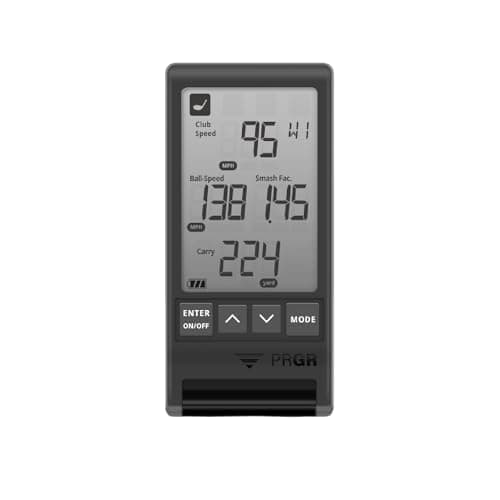
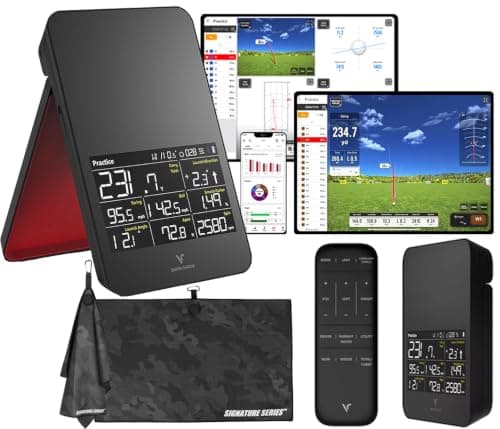
These two are the honest answer for the golfer who wants numbers at the range without a phone in the loop, an app account to manage, or a subscription quietly compounding in the background — because neither the Voice Caddie SC4 Pro nor the PRGR HS 130-A asks for any of that. Both are self-contained doppler radars that read your shot and show the result on their own built-in screen. The difference is how much they read. The Voice Caddie SC4 Prois a standalone monitor that reads carry distance, ball speed and the core numbers of a range session, and it’s sold as a monitor-and-simulator bundle. The PRGR HS 130-A is a tiny pocket unit that reads ball speed, club speed, smash factor and an estimated distance, and not much more. Check the live prices above first, because the PRGR sits in a lower price class than the SC4 Pro, and that gap is the heart of the choice.
At a glance
| | Voice Caddie SC4 Pro | PRGR HS 130-A |
|---|
| What it reads | Carry distance, ball speed and the core range numbers | Speed only — ball speed, club speed, smash factor, estimated distance |
| How it reads it | Doppler radar, nothing on the ball | Doppler radar, nothing on the ball |
| Where you read it | Its own built-in display, no phone | Its own on-unit LCD, no phone |
| Running cost | No subscription — batteries only | A set of AAA batteries — nothing else |
| Home simulator | Basic sim bundled with the monitor | None — it’s a speed trainer |
| Best for | Standalone carry-and-speed practice, no phone | Cheap, pocketable speed and smash training |
Choose the Voice Caddie SC4 Pro if…
You want the fuller range picture— your real carry per club, not just how fast the ball left the face — on a screen you can read at a glance. The SC4 Pro is a self-contained doppler monitor with its own display, so you set it down, swing, and read your carry and ball speed off the unit itself, with no pairing, no login and no renewal notice. Knowing your true carry distances is the single most useful thing a monitor can teach a mid-handicapper, because most amateurs club themselves off a best-ever number they hit once and come up short all day, and the SC4 Pro puts that honest figure in front of you every swing. It’s also sold as a monitor-and-simulator bundle, so a basic home-sim function is part of the package if you want to dabble. The trade you accept is price and size: it sits in the sub-$1,000 class rather than the pocket-speed price class, and it’s a larger, real-money purchase. The full case is in our Voice Caddie SC4 Pro review.
Choose the PRGR HS 130-A if…
You only want speed and smash, cheaply and in your pocket. If your practice is speed training — chasing clubhead speed, checking ball speed and smash factor, confirming an overspeed protocol is actually adding miles per hour — the PRGR gives you the number the instant you swing, off its own little LCD, with no phone and no fee. It weighs about four-and-a-half ounces, runs on AAA batteries, stores your recent shots on the unit itself, and it even reads clubhead speed without a ball, which makes it a genuine overspeed-training companion. Its running cost is a set of AAA batteries, full stop. The honest limit is that it reads speed metrics only— no launch angle, no spin, no true carry mapping and no simulator, and its shot history is a short on-device log. That narrowness is the point: it does the speed job for a fraction of the SC4 Pro’s price and none of the bulk. Full detail in our PRGR HS 130-A review.
How they differ
Start with what they share, because it’s unusual: both are doppler radars, both read off their own built-in screen with no phone, and neither charges a subscription. That already sets them apart from most of the field — there’s no app tier to unlock on either, and nothing gated behind a membership. So the decision isn’t about frictions the way a Rapsodo-versus-radar choice is; it’s about data breadth and price. The SC4 Pro reads carry distance and the core numbers of a full range session and adds a basic bundled simulator; the PRGR reads speed, smash and an estimated distance, and stops there. If you want to know your real carry per club and watch a session actually go somewhere, only the SC4 Pro tells you that; if you only want to build and check speed, the SC4 Pro’s extra breadth is capability you’re paying for and won’t use. And on size, the PRGR is the more pocketable of the two by a distance — it’s the unit that lives permanently in the bag.
A note on accuracy
Neither of these is a five-figure fixed system, so set expectations by what each is for. Both read your shot with doppler radar, which means spin, where it’s reported at all, is modeled from ball flight rather than measured optically — the SC4 Pro treats spin as a trend, and the PRGR doesn’t read it at all. Lean on the readings each unit is built around: the SC4 Pro’s carry and ball speed, and the PRGR’s ball speed and smash. The PRGR in particular has a strong reputation for the narrow job it does — independent side-by-side reviews have reported its ball-speed tracking close to far pricier units, which is a big part of why speed-focused golfers rate it. Its distance figure, like any radar’s, is estimated rather than measured. We base all of this on the manufacturers’ published specifications and how doppler radar captures a shot; we don’t run a testing lab and don’t pretend to.
The workflow, in practice
Because both units carry their own screen, they share the biggest workflow advantage in the category: nothing to pair, nothing to log into, no phone battery to worry about. You switch either one on and the number is right there in your eyeline. Where they differ day to day is bulk and breadth. The PRGR is the one you pull out of the bag for a two-minute speed check anywhere, point down the line, and swing — the number is on the LCD before your follow-through finishes. The SC4 Pro is a slightly bigger deployment for a slightly bigger payoff: you stand it up, and in return you get carry mapping and a basic sim rather than speed alone. Neither asks you to keep a tablet charged or fight a flaky range signal, which is exactly why both appeal to the phone-averse practicer.
Which one improves your game faster?
The better tool is the one that fixes your actual fault. If your scores are held back by distance and gapping— you don’t know your real carries, you come up short on approaches, your club selection is a guess — the SC4 Pro is the one that changes that, because seeing your honest carry per club is how you stop leaving approach shots in the front bunker. If your game is held back by clubhead speedand you want a number to chase through a speed-training block, the PRGR gives you that feedback instantly and cheaply, session after session, with nothing to set up. Plenty of improving golfers genuinely need the first; plenty of longer hitters working on speed need the second. Name your fault and the monitor picks itself — and if you’re not sure which fault is costing you most, weighing both against the wider field in our portable launch monitors roundup helps you place them.
Can you own both?
It’s a more sensible pairing than it sounds, because the two barely overlap. A committed practicer might stand the SC4 Pro up next to a net for real sessions — mapping carries, watching ball speed, running the bundled sim — and let the PRGR live permanently in the bag for a quick speed check on any range, anywhere, without unpacking the bigger unit. At their very different prices that’s not an extravagant combination, and because neither charges a subscription, owning both adds nothing recurring to your costs beyond a few sets of batteries. If a single purchase has to cover everything, though, buy for your main fault first — carry and gapping point to the SC4 Pro, pure speed work points to the PRGR — and add the other later if you find you miss it. Where the budget is the real constraint, see how each stacks up against the wider field in our no-subscription roundup.
Skip the decision entirely if…
Neither is the right answer if what you actually want is optically measured spin and shot video. Both of these are pure doppler radars, so measured spin and a swing replay are simply not what they do — a camera unit like the Rapsodo MLM2PRO is the tool for that, at the cost of its subscription. And if a recurring fee is a hard no for you but you want to see the wider field of units that never send a renewal notice — several of which read a fuller data set than the PRGR — start with our no-subscription roundup. Both the SC4 Pro and the PRGR earn their place on that list; this comparison just decides which of the two fee-free pockets fits how you practice.