Yes, you can use a hunting rangefinder for golf— the laser and the optics are essentially the same hardware, and it will give you a distance. There are exactly two catches, and both are real. First, target priority: a hunting unit is usually tuned to read the farthest or largest object in its field, which on a golf course is the treeline behind the green rather than the flagstick in front of it. Second, the slope rule: many hunting models calculate an angle-compensated “true” distance and plenty of them cannot be switched off, which makes the device non-conforming for competition play under Rule 4.3a(1). If you hunt and play golf occasionally, use what you own. If you play competitions or hate re-shooting a target, buy the golf one.
What is genuinely different
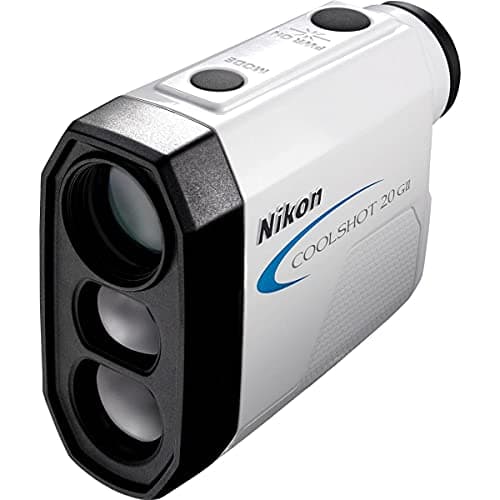
Target priority is the whole story. Golf lasers advertise first-target priority: when several objects sit in the beam, the unit reports the nearest one, because a flagstick is a thin object in front of a wall of trees. Nikon publishes exactly this on the Coolshot 20 GII as its First Target Priority algorithm. Hunting lasers commonly use distant- or large-target priority instead, because an animal standing in brush is behind the grass the beam clips on the way. Point a distant-priority unit at a flag and it will happily tell you the distance to the treeline forty yards past it, which is worse than useless: it is plausibly wrong.
Slope, and whether it can be turned off. A golf laser with slope is built with a switch, a visible indicator or a removable faceplate, precisely so it can be made conforming for competition. A hunting unit that computes angle-compensated distance often has no such switch, because nobody hunting needs one. That is the difference between a legal device and an illegal one, and it is not about the number it shows.
Flag-lock feedback.Golf models add a confirmation that they have actually acquired the pin — a vibration pulse, a jolt, a ring in the display. That is a convenience feature, not a physics feature, and it is the one most golfers end up valuing most, because it removes the question of whether the number you just read is the flag or the bush behind it.
Magnification, size and mounting. Both categories cluster at 6x. Hunting units are often larger, sometimes with a tripod thread; golf units are pocket-sized and increasingly magnetic so they stick to a cart rail. The Nikon Coolshot 20 GII is published as a compact sub-5-ounce body, which is the golf-specific priority.
The comparison in one table
| Feature | Hunting rangefinder | Golf rangefinder |
|---|
| Target priority | Usually distant or largest target | First / nearest target |
| Pin acquisition feedback | Rare | Standard (vibration or display confirmation) |
| Slope | Often always on, often not switchable | Switchable, or absent by design |
| Competition legality | Frequently non-conforming as supplied | Conforming with slope off or absent |
| Magnification | Typically 6x | Typically 6x |
| Size and mounting | Larger; tripod threads common | Pocket-sized; magnetic mounts common |
What the rule actually says
A distance-measuring device may be used to measure distance only. Using it to measure elevation change, wind or other conditions affecting play, or to get a recommended line of play or club selection, breaches Rule 4.3a(1). Crucially, a device is permitted to havethose extra functions as long as they are not used during the round — which is why a switchable-slope golf laser is fine with slope off, and why a hunting unit that computes angle-compensated distance with no way to disable it is a problem. Our rangefinder legality guide and what slope is cover this in full. Three lasers that settle the question cleanly follow.
When using your hunting unit is genuinely fine
A casual round with friends, no card, no competition. In that setting your hunting laser gives you a number, you learn to re-shoot when it looks wrong, and you have saved the price of a second device. Two habits make it workable: aim at the baseof the flagstick where it is against the green rather than silhouetted against trees, and take the shortest of three readings rather than the first. If your unit happens to offer a near-target or “first target” mode in its menu — some do — switch it on and most of the problem disappears.
When to buy the golf one
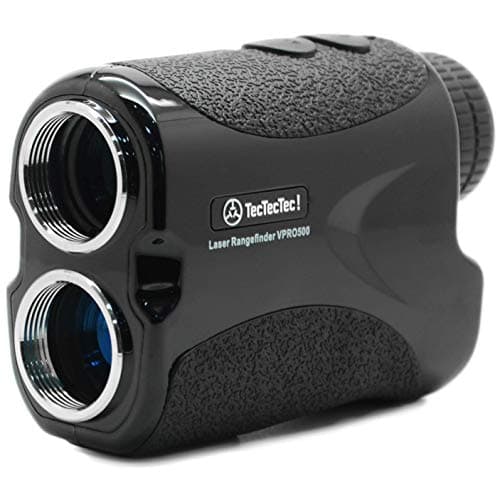
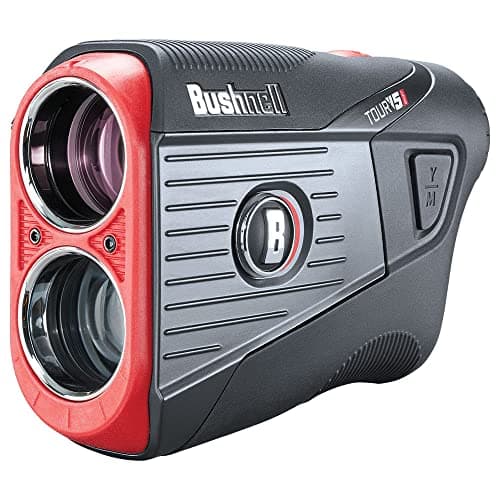
Three triggers. You play competitions, in which case a unit with unswitchable slope is not an option and it is not worth the argument. You play more than a round or two a month, where re-shooting every approach stops being a quirk and becomes the reason the device stays in the bag. You want slope deliberately for practice rounds, which means you want it switchable rather than permanent. The three picks here map onto those cases: the Nikon Coolshot 20 GII has no slope at all and so is always legal, the TecTecTec VPRO500 is the cheapest route into a golf-priority laser with slope, and the Bushnell Tour V5 Shift pairs switchable slope with the magnetic mount.
The reverse question: can you hunt with a golf rangefinder?
Less well, and for the mirror-image reason. First-target priority means the laser reports the nearest object in the beam, which when you are ranging an animal through brush is the brush. Golf units are also typically shorter-ranged, since nothing on a golf course is six hundred yards away, and few have tripod mounts. It will work on a clear target in the open. It is the wrong tool in cover, which is exactly the situation hunting lasers are built for.
One more option worth considering
If the reason you were hoping to reuse a hunting unit is budget, a GPS is the other way out. A clip-on or watch GPS gives you front, middle and back yardages with no line of sight, no target priority problem and no slope question, often for less than a decent laser. See no-subscription GPS watches and rangefinder vs GPS for the trade.