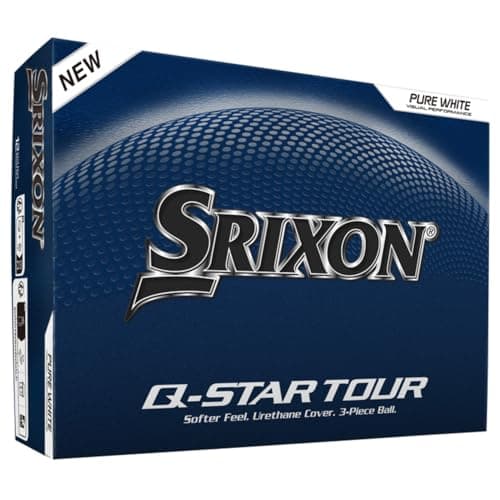
If this site has a single most-recommended golf ball, it’s the Srixon Q-Star Tour — and this review explains why, honestly. The Q-Star Tour is the value-tour ball: a genuine urethane cover, the thing that actually separates a tour ball from a value ball, at a price a clear rung below a Pro V1. It’s the ball we point improving golfers toward the moment they stop losing a sleeve a round, because it delivers most of the tour-ball benefit for meaningfully less money. It isn’t the ball for everyone — a fast player with a tour-sharp short game will out-grow it, and a golfer still drowning golf balls should wait — but for the huge band of players in between, it’s the smartest ball in the shop.
What the Q-Star Tour actually is
Srixon builds the Q-Star Tour as a three-piece ball with a soft urethane cover — the same category of cover as a Pro V1, a TP5 or a Chrome Soft, and the thing that grips a wedge and stops the ball on the green. What sets it apart is the price and the compression. It sits in the mid-price tier rather than the premium one, and its mid compression is softer and more forgiving than a firm tour ball’s, so it doesn’t demand tour clubhead speed to compress. Those are Srixon’s claims and widely published construction facts, not numbers we measured — we don’t run a lab, and we say so on how we rank— but they match how the ball plays: real greenside bite, a feel a moderate swing can actually load up, and a price that doesn’t punish a lost ball the way a premium does.
The short version: this is the bridge ball. You get the urethane cover that matters, minus the top-tier price and minus the firm compression that a slower or moderate swing can’t use. It’s most often cross-shopped against the benchmark it undercuts and the soft premium a tier above it — we settle both in Q-Star Tour vs Pro V1 and Q-Star Tour vs Chrome Soft.
Where it shines
The headline strength is that it gives you the cover that counts for meaningfully less. A urethane cover is the single feature that separates a tour ball from a value ball, and the Q-Star Tour has a real one — you get the one-hop-and-stop bite around the green without paying Pro V1 money for it. For the improving golfer who has started keeping the ball in play, that is the whole ballgame, and it’s why this is the ball we point to first.
The second strength is the mid compression, which is quietly the reason it suits so many players. A firm tour ball needs real speed to compress; feed it a moderate swing and it leaves distance on the tee. The Q-Star Tour’s mid compression is easier for a wider range of swing speeds to flatten, so a moderate swing gets more distance and better feel from it while still getting urethane spin. It is genuinely more forgiving of your swing speed than a premium ball, without giving up the cover.
The third strength is value, and it’s the metric where the Q-Star Tour beats every premium on this site. You’re not paying for the last few percent of spin consistency you can’t yet use, and the lower price means every ball lost to a hazard stings a fraction as much. For the mid-handicapper who wants greenside spin without the premium tax, it is the sweet spot, and nothing else here occupies it as cleanly.
Where it falls short (honestly)
The Q-Star Tour’s limitations are real but narrow. It isn’t quite the ball a full premium is at the very top of the range: you give up a little durability and the last few percent of spin consistency and flight repeatability that a $50 ball delivers. For a tour-caliber short game that can feel those refinements, that gap is findable — it’s exactly what the extra money buys on a Pro V1 or a Chrome Soft. For everyone else it’s academic.
The other honest caveat runs the opposite way. The Q-Star Tour still costs more than a two-piece value ballyou might lose just as fast, so it is not the right buy while you’re still feeding golf balls to the water. The urethane cover is wasted money if it spends its life at the bottom of a lake. It’s a step up you earn by keeping the ball in play, not a default for every improving golfer.
Who should buy it
Buy the Q-Star Tour if you want real urethane greenside spin without paying the top-tier price, or if your swing is moderate rather than tour-fast. It is the natural first urethane ball for the golfer stepping off a value ball — you’ve started keeping most of your golf balls in play, your wedge contact is clean enough that a urethane cover actually rewards it, and you’d rather not spend Pro V1 money to find out. Its mid compression means you don’t need a fast swing to get the most from it, and its price means a lost ball is a shrug rather than a wince. For the improving and mid-handicap player, this is the ball, and it’s the one we recommend more than any other on the site.
Who should skip it
Skip it in two cases, one at each end. If you lose two or three golf balls a round, wait: the urethane cover you’re paying for only matters if it stays out of the water, so play a soft value balluntil your ball-in-play rate climbs, then come back. And if you’re at the other end — a fast swing with a tour-sharp short game that spins wedges on demand and keeps the ball dry — you may genuinely feel the last few percent the Q-Star Tour gives up, and the full premium is worth it for you. That’s the honest ceiling of this ball: it’s the smartest buy for the broad middle, not the maximum for the top or the right economy for the golfer who hasn’t stopped losing sleeves. Weigh the trade in are expensive golf balls worth it.
How it stacks up against the field
Against the field, the Q-Star Tour’s case is value: the same category of cover as the premiums, at a lower price and a friendlier compression. The Pro V1is the firmer, more consistent benchmark it’s built to undercut, worth the premium only once your swing and short game can bank it. The Chrome Softis the soft premium a tier up, trading price for a softer feel and Triple Track lines. Against both, the Q-Star Tour’s pitch is the same: most of the ball for less of the money. Where it sits against the full fieldis unusual for a urethane ball — near the top on value, which is exactly why it’s the one we recommend most.
The bottom line
The Q-Star Tour is the ball more golfers should be playing than any other on this site. It gives an improving player the one thing that actually separates a tour ball from a value ball — a real urethane cover — wrapped in a forgiving mid compression and priced a clear rung below the premiums. It isn’t the last word in spin or durability, and it isn’t the right economy for a golfer still losing sleeves. But for the enormous band of players between those extremes — keeping the ball in play, striking wedges cleanly enough to want spin, unwilling to spend Pro V1 money to get it — it is simply the smartest golf ball going. Buy it the moment you stop drowning them, play it every round, and spend what you saved on the part of your game that needs it.