The best golf tee for most golfers is a box of plain 3-1/4 inch hardwood tees, bought in a count large enough that snapping three in a round is not an event. That is an unglamorous answer and it is the honest one, because the tee category is built on a claim nobody can verify from a spec sheet: that a particular top design reduces friction at impact and therefore adds yards. We have not measured a tee. We do not have a lab, we say so on how we rank, and we are not going to launder a brand’s marketing into a finding. So this page ranks on the two properties of a tee you can check for yourself: whether it gives you the same height every time, and whether it is still in one piece afterwards.
That reframing changes the order completely. Judged on repeatable height, the most expensive thing here wins and the cheapest thing here is mid-table. Judged on cost per round, it inverts. And the single most useful purchase on the page for most readers is not the top pick at all — it is the short tee at number five, which costs almost nothing and fixes a problem most golfers do not know they have.
The criteria, in the order they decide the ranking
Four questions, asked of every tee. The first two are facts you can observe; the third is arithmetic; the fourth is the rulebook. Notice what is absent: a distance claim.
- Does it give you the same height every time?This is the only property of a tee that plausibly changes your golf, and it is the one nobody markets. A driver swing is calibrated to where the ball sits relative to the crown of the club. If the height moves a quarter of an inch between tee shots — because the ground was harder, or because you pushed the tee in further, or because the prongs on a tired tee have splayed — your strike height moves with it.
- Does it survive the shot? Durability is not just a cost question. A tee that bends but does not break is the sneakiest source of inconsistent height there is, because it still looks usable. Wood solves that by failing obviously. Good plastic solves it by not deforming at all. Mediocre plastic does neither.
- What does a round actually cost? Cost per tee is the wrong number. Cost per round is the right one, and it depends entirely on whether you are the kind of golfer who walks off the tee box without looking down. Be honest with yourself about that before you buy a four-pack of anything.
- Is it conforming?The Equipment Rules define a tee as “a device designed to raise the ball off the ground” and set three limits: it must not be longer than 4 inches (101.6 mm), must not be designed or manufactured in a way that could indicate line of play, and must not unduly influence the movement of the ball. Every tee here is well inside the length limit. The “indicate line of play” clause is the one to think about if you ever consider lining tees up as an aid.
Length matters more than material. Almost nobody buys for it
If you take one thing from this page, take this: the length of the tee is a bigger decision than what it is made of, and most golfers own exactly one length and use it for everything.
A modern driver head is built right up to the 460 cc volume ceiling the equipment rules allow, which makes it tall as well as wide. Teeing the ball so that its equator sits at or just above the crown — the position that lets you catch it on the way up — needs roughly two inches of tee above the turf. On a soft spring tee box a 2-3/4 inch tee manages that. On a baked-out August tee box it does not, because you cannot get it deep enough to be stable. That is why 3-1/4 inches is the standard driver length: not because you need all of it, but because you need the option.
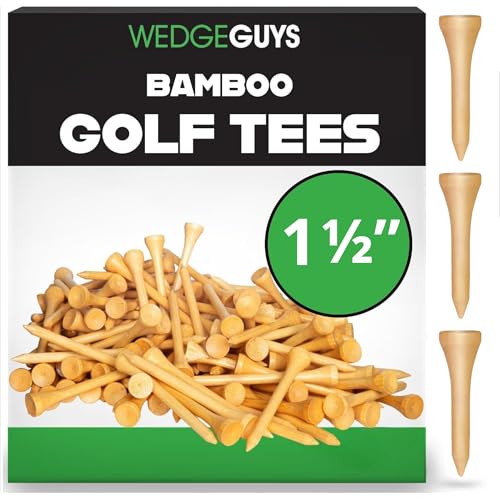
Now the opposite case, which is the one that quietly costs people shots. On a par 3 you are hitting an iron or a hybrid, and an iron wants a descending strike into a ball sitting a few millimeters off the turf. Tee that ball an inch up on your driver tee and you have to sweep it, which is not the swing you have grooved, so it comes off high and short with no spin. The fix costs the price of a sandwich: a 1-1/2 inch tee. It is pick five below and it is the best value on the page.
Why plain wood wins anyway
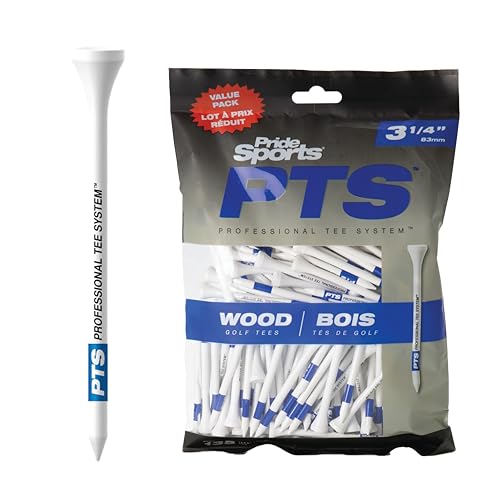
Our top pick is a 135-count box of hardwood tees, and the count is the feature. Wood is the only material here that fails honestly: it snaps, you see two halves, you take a fresh one, and the fresh one is identical to the last fresh one. That is repeatability by a different route than the brush tee at number six uses, and it costs a fraction as much.
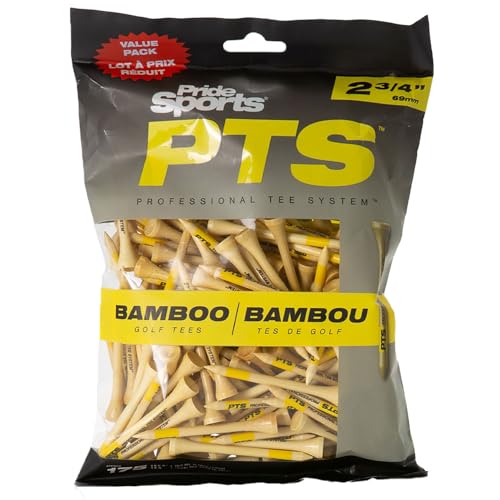
PrideSports brands these as the “#1 Wood Tee on Tour”, and it is worth being precise about what that does and does not tell you. It is a claim about who uses them, not a performance test. But it is a genuinely useful piece of context: the players with the most to gain from a friction-reducing tee top, and the easiest access to one, are mostly still using a plain piece of wood. Draw your own conclusion about how much the top design is worth.
The prong, cup and brush tees: what they really buy you
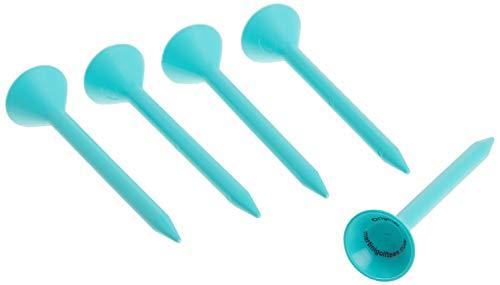
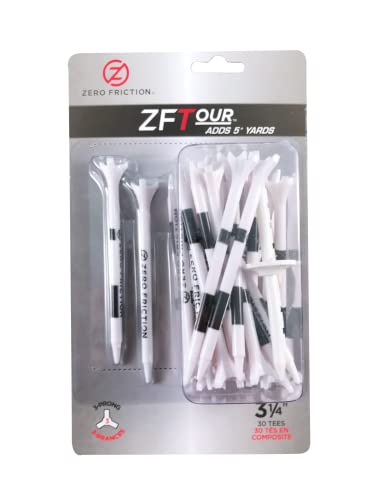
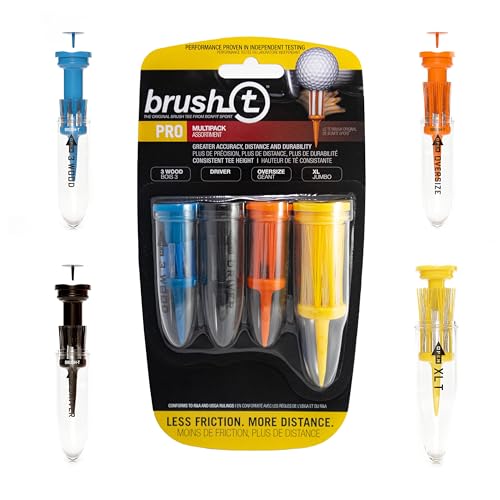
Three designs on this page replace the conventional cup with something that touches less of the ball — Martini’s oversized cup, Zero Friction’s three flexible prongs, BRUSH-T’s bristles. All three market a reduced-friction, more-distance benefit. We are not repeating that as a finding, and you should not pay a premium expecting yards.
What they do reliably deliver is different and better than the marketing: they survive. A prong bends out of the way instead of shearing; a plastic cup flexes; bristles compress. One of these tees can last a whole season, and a tee that lasts a season is a tee whose height never changes. If you have ever wondered why your driver contact wanders between thin and high on the face, a tee that bends and springs back to the same shape is a more plausible answer than anything a brand prints on the bag.
The honest cost warning: these invert the economics. Wood is cheap per tee and you lose them freely. A four-pack of brush tees is expensive per tee and the entire value case collapses the first time you leave one in the ground. If you are not the sort of person who checks the tee box before walking off, buy wood and stop reading this paragraph.
Bamboo: the compromise that is not a compromise
Bamboo sits between the two camps and deserves more attention than it gets. It is a grass rather than a timber, and its fibers run long and straight, which is why tee makers can build lengths in bamboo that would be flimsy in softwood. It is still biodegradable, it still fails visibly, and it comes in the big counts that make a consumable sane to own.
We rank two bamboo tees for two different jobs: a 2-3/4 inch box as the single-box answer for anyone who tees a driver, a fairway wood and a hybrid and does not want to carry three lengths, and the 1-1/2 inch box as the par-3 tee everyone should already own. If you are going to buy two things off this page, buy those two.
Skip this: a tee bought for distance
Every honest roundup on this site names something to skip, and here it is a purchase reason rather than a product. Do not buy a tee because of a yardage claim. The claims are unmeasured by us and mostly unmeasurable by you, the differences being argued over are small, and the money is better spent almost anywhere else — a fresh glove you are not strangling the club through, or grips that let you hold on lightly, both change what the club does far more than the thing holding the ball up.
Buy a tee for height, for durability, and for a count that matches how many you lose. Then go spend the saved money on a lesson.
Which length for which club
Tee length is sold in inches of total tee, not inches above the ground, so the usable height is always less than the number on the box. Here is the working rule for each club, assuming a normal tee box rather than concrete.
| Club off the tee | Tee length to buy | Why |
|---|
| Driver (460 cc head) | 3-1/4 in | Needs about two inches above turf to get the ball’s equator at the crown; the extra length is insurance against firm ground |
| Driver, soft turf only | 2-3/4 in | Enough height when the tee pushes in easily; marginal in August |
| Fairway wood / hybrid | 2-3/4 in | A shallower face wants the ball lower; a driver tee sits it too high |
| Long iron / driving iron | 1-1/2 in | Keeps a descending strike available instead of forcing a sweep |
| Mid or short iron on a par 3 | 1-1/2 in | A few millimeters of air under the ball is the whole point — you want your normal iron swing |
The cost-per-round math, which is the only math that matters
Nobody compares tees properly because everybody compares the price of the bag. The number that decides this category is cost per round, and it has two inputs: how many tees you destroy, and how many you abandon. Only one of those is about the tee.
Work it out like this. Count how many tees you went through last time you played. Most golfers who tee up every par 4 and par 5 and lose a couple will say three or four. Now split that number: how many actually broke, and how many were simply left behind? A durable tee only fixes the first number. If most of your losses are abandonment, a four-pack of premium tees has a cost per round that will genuinely annoy you, and a 135-count box of wood has one you will never think about again.
This is the same logic we apply to every consumable in the bag — see when to replace grips and when to replace a golf glove for the two that cost real money. A tee is the cheapest item in that family by an order of magnitude, which is exactly why it is worth two minutes of thought rather than none: it is the one place where buying the right thing costs you nothing.
What the rules actually say
Three limits, and they are shorter than most golfers assume. A tee must not be longer than 4 inches (101.6 mm). It must not be designed or manufactured in such a way that it could indicate line of play. And it must not unduly influence the movement of the ball. Every tee on this page is conforming on all three counts, including the brush and prong designs — a differently shaped top is not in itself an influence on the ball within the meaning of the rule.
The clause worth remembering is the middle one. Tees joined with string, or any arrangement of tees set up to show you an alignment, can fall foul of the line-of-play limit. If you want a reference line, use alignment sticks on the practice ground, where there is no rule against it and the feedback is better.