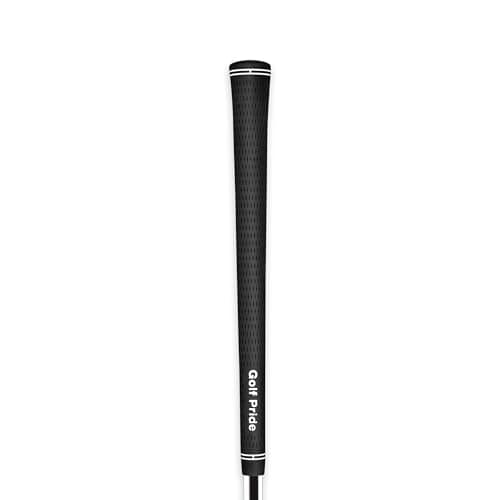
Grip size is set by one measurement: from the crease of your wrist to the tip of your middle finger, on your upper grip hand. That is Golf Pride’s own published method, and the number it gives you maps straight onto the four sizes every major grip is sold in. Most golfers are a standard. A meaningful minority are playing a standard when the chart says midsize, because standard is what came on the clubs and nobody ever measured.
The golf grip size chart
This is Golf Pride’s published chart, reproduced as they state it. It gives two ways in — a hand measurement, and a glove size — and they are meant to agree. When they disagree, trust the hand measurement: glove sizing varies between brands in a way a ruler does not.
| Grip size | Hand length (wrist crease to middle fingertip) | Glove size |
|---|
| Undersize | 5″ – 6.5″ | Men’s S, Cadet S, Women’s S, M |
| Standard | 6.6″ – 7.5″ | Men’s M or M/L, Cadet M or M/L, Women’s M/L, L |
| Midsize | 7.6″ – 9″ | Men’s L, XL or Cadet L, XL |
| Jumbo | Over 9″ | Men’s XL, XXL, XXXL, Cadet XXL |
Those ranges are Golf Pride’s, not ours — the source is linked at the bottom of the page. What we will add is the judgment the chart cannot make for you, which is what to do when you land near a boundary, and what a size actually changes in your hands.
How to measure, in thirty seconds
- Open your upperhand flat — the left hand for a right-handed golfer, the right hand for a left-handed one. This is the hand that sets grip size; the lower hand does not get a vote.
- Lay a ruler or tape along the palm from the crease of the wrist to the tip of the middle finger. That whole length is the number, not just the fingers.
- Read it to the nearest tenth of an inch and take it to the chart above.
Two things go wrong here. People measure to the base of the fingers rather than the fingertip and come out an inch short, which pushes them a full size down. And people measure the wrong hand. If your number lands within about a tenth of a boundary, treat yourself as between sizes and read the tape section below rather than guessing.
What each size actually changes
Size is not comfort trim — it changes how much your hands can work through impact. A grip that is too small encourages the fingers to over-work and the hands to close the face; a grip that is too large quiets the hands and can leave the face open. That is the mechanism behind the old range-lesson shorthand that a bigger grip “reduces the hook” — not magic, just less hand action available. It also means a badly sized grip fights a swing change you may be paying a coach for.
| If your grip is… | What you tend to feel | What it tends to do to the ball |
|---|
| Too small | Fingers dig into the palm; you grip harder than you mean to | Hands over-active, face closing — the left miss for a right-hander |
| Correct | Fingertips just touch the pad of the palm, with light pressure | Nothing. Which is the point — a correct grip is invisible |
| Too large | The hand feels spread and the hold feels “on top of” the club | Hands quiet, face slow to square — a push or a fade that will not go away |
The bit nobody mentions: .580 vs .600 cores
Every grip has a core diameter, and the two you will see are .580 and .600. Golf Pride states the practical consequence plainly: a .58 core standard-size grip on a .600 shaft will feel thickerthan a .60 core standard-size grip. So “standard” is not one fixed diameter once it is on a club — it is the grip size plus how the core meets your shaft. This is why two sets both labeled standard can feel different, and it is worth knowing before you decide the chart is wrong about you. If you are ordering online and your shafts are .600 butt diameter, a .58 core is a free half-step up in feel.
Between two sizes? Use tape, not a guess
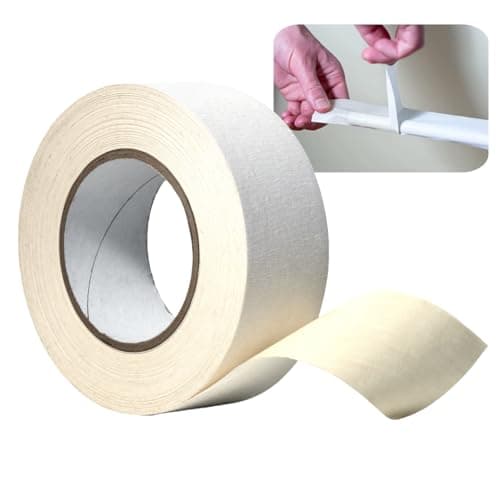
This is the most useful thing on the page. Golf Pride’s own guidance is that you can get an in-between feel by adding 2 to 4 wraps of tape under the grip to increase the size slightly. That gives you a genuine intermediate between standard and midsize, tuned in steps, for the price of a roll of tape rather than a second set of grips.
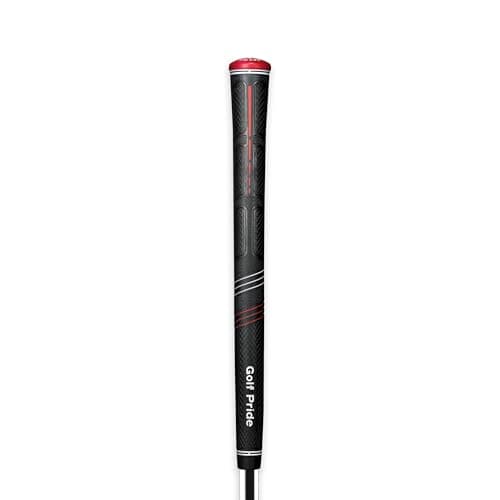
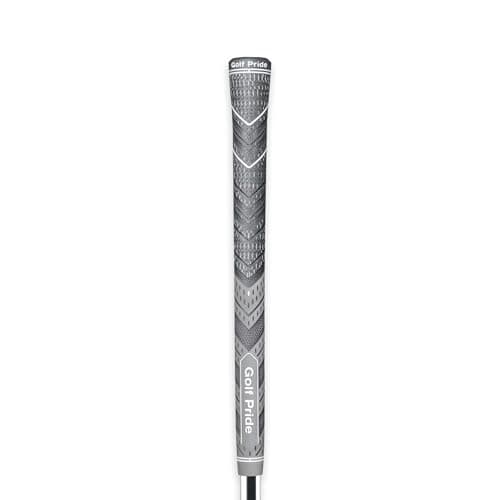
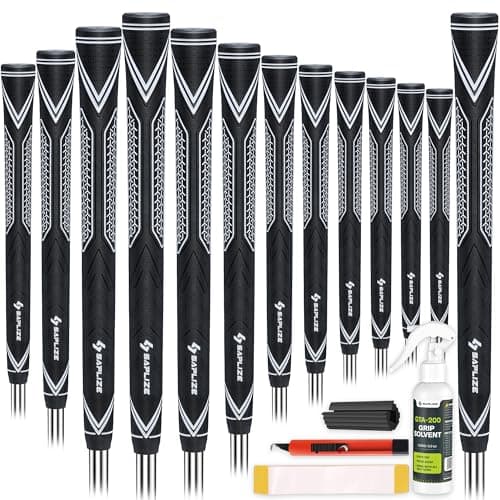
A related option if only your lower hand feels cramped: the MCC Plus4 is built with a larger lower-hand diameter that Golf Pride describes as simulating four extra wraps of tape — a factory version of exactly this trick, applied to one hand only. And if you want the whole bag resized at once without pricing thirteen individual grips, a full 13-grip set like the SAPLIZE G50 is the cheap way to change size across every club.
Sizing a putter grip is a different question
Do not size a putter grip from this chart. Putter grips are the one exception in the Rules of Equipment: they may legally be non-circular in cross-section, where grips on every other club must be circular. That is why flat-fronted, oversize and counterbalanced putter grips conform. Putter grip size is chosen to quiet the hands and set the stroke, not to fit the hand length, so an oversize putter grip on standard-size iron grips is a completely normal combination.
When to re-check your size
Grip size is not a one-time decision for everybody. Re-measure if you have moved up or down a glove size, if arthritis or joint pain has changed what your hands tolerate — our grips for arthritis guide covers the oversize, low-pressure options — or if you are a junior still growing. Otherwise, size it once, then simply replace like for like on schedule: our how often to regrip guide has the interval, and how to regrip at home has the method and the kit.