Skip to content
Divot&Draw

The Numbers · Launch Monitors

The Best Golf Hitting Mats Under $100

A cheap mat is the fastest way to practise at home - and the fastest way to hurt a wrist and learn a fat strike. Three that are worth buying, and the honest limits of the band.

By Stephen V.Updated How we rank
#ad

We earn a commission when you buy through our Amazon links, at no extra cost to you. It never changes our rankings — and we'll tell you when the cheaper ball or club is the better buy. How this works.

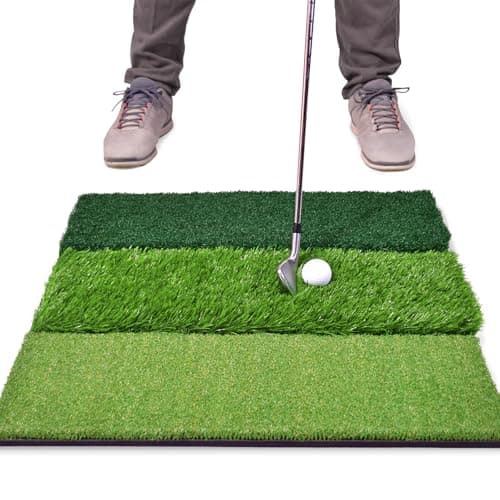
GoSports GoSports Tri-Turf XL Golf Hitting Mat (24 x 24 in)
$59.99View on Amazon

Price as of November 18, 2026. Prices change — Amazon's is the one that counts.

#ad · we may earn a commission from this link to GoSports Tri-Turf XL Golf Hitting Mat (24 x 24 in)

For the golfer who wants to practise out of rough and off a tee as well as a fairway lie, in a pad small enough to live in a garage.

Budget pick

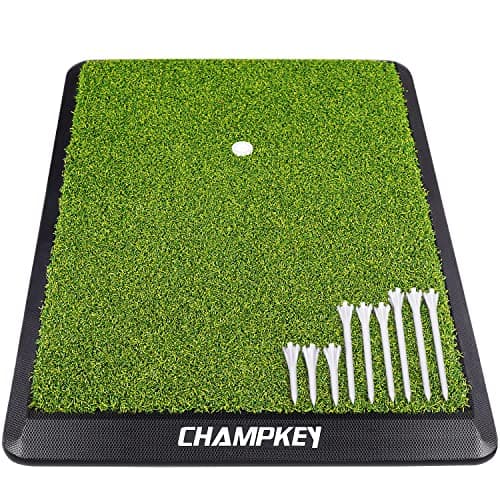
CHAMPKEY Premium Synthetic Turf Golf Hitting Mat — one honest single-density surface on a rubber base, and no pretense about anything else $29.99 on Amazon

The verdict: the GoSports Tri-Turf XL is the pick under a hundred dollars, and it is for the golfer who wants more than one lie to practise from — three surfaces on a single rubber-backed pad, in a footprint that stores in a garage. Budget pick: the CHAMPKEY Premium Synthetic Turf mat, which is one single-density surface on a heavy rubber base and makes no claim to be anything else, which is exactly what you want at the bottom of a band. Prices come from our live price layer, stamped November 18, 2026.

This is a deliberately small page, and the reason is the point of it. Only three mats in our registry sit under a hundred dollars with a live price, and we are not going to pad the list to five by including things that cost more and calling the band approximate. Three is the honest count. What matters far more than the count is understanding what you are buying, because a budget hitting mat has one genuine risk and one genuine blind spot, and neither of them appears in a product description.

The risk: a thin mat on a hard floor

The single most important thing about a cheap mat is not the turf. It is what the turf is sitting on and how thick the pad underneath is. A thin pad on concrete has almost no give, so when you catch the ball slightly fat — which is the entire point of practising — the club does not dig, it bounces, and that shock goes straight into your lead wrist and elbow. Golfers who practise a lot on thin mats on garage floors get sore for this reason, not because they swing badly.

Two mitigations, both free. Put the mat on grass, carpet or a rubber horse-stall mat rather than directly on concrete, and limit how many balls you hit in one session off any budget mat. If your home bay is going to be on concrete and you intend to practise seriously, this band is the wrong band and you should read the full mat roundup, where the thicker cushioned options live. We would rather send you up a tier than sell you a sore wrist.

The blind spot: a mat hides a fat shot

Every hitting mat, at every price, lies to you about one thing. Turf fibres and a rubber base let the sole of the club skid forward into the ball even when your low point was two inches behind it, so a chunk that would have been a divot-first disaster off grass comes off the mat feeling fine and flying almost normally. Practise long enough on a mat without knowing this and you can groove a low point that does not work on a golf course.

The fix is cheap and it is the single best piece of advice on this page: put something on the mat that records where you actually bottomed out. A strip of impact tape, a line of foot spray, or a dedicated strike-feedback board like the Divot Board turns a mat from a surface that flatters you into a surface that tells you the truth. Our home-practice guide covers the same point for the rest of a home setup.

One surface or three

The genuine feature difference in this band is whether you get a single fairway-length turf or a tri-turf pad with fairway, rough and tee sections. Three surfaces is worth the step up for one specific reason: a ball sitting down in rough demands a steeper angle of attack and a different club selection, and that is a skill you cannot practise on a fairway-length mat at all. If you only ever want to rehearse a clean lie — and plenty of golfers do, as a warm-up or a tempo session — the single-surface option is not a lesser product, it is a cheaper one that does the job you want.

What none of the three does is accept a real tee. Budget mats are too thin and too dense, so you get a rubber tee holder instead, with whatever fixed heights it offers. That is the clean dividing line between this band and the next one up, and it matters if driver practice is the reason you are buying.

Skip this: buying a mat before you have somewhere to hit into

The most common sequencing mistake in home practice. A mat is the cheapest component of a home setup and the least useful on its own: without a net you are limited to short chips in a garden, and without anything measuring the result you are hitting balls rather than practising. Buy the net first if you have neither, add the mat second, and add something that gives you a number or a mark third. Our what-a-home-setup-costs breakdown puts honest running totals against each stage, and the practice-net roundup covers the piece that should come first.

The short answer

Quick picks

#ProductBest forScorePrice
01
GoSports GoSports Tri-Turf XL Golf Hitting Mat (24 x 24 in)
GoSports Tri-Turf XL Golf Hitting Mat (24 x 24 in)

Three lies in one 24-inch square — the practice mat for working a ball out of rough as well as off a fairway.

Varying the lie without buying three mats
8.4
$59.99Amazon
02
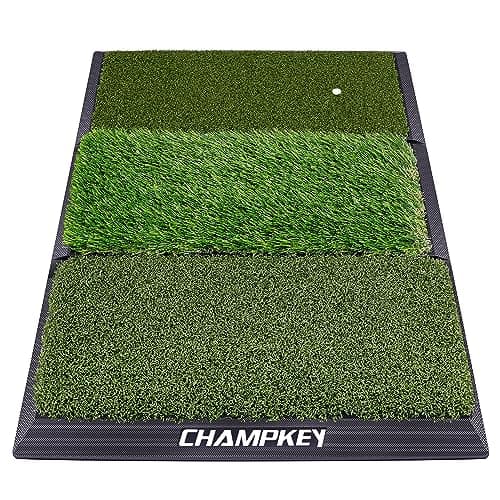
CHAMPKEY CHAMPKEY Professional Tri-Turf Golf Hitting Mat
CHAMPKEY Professional Tri-Turf Golf Hitting Mat

The cheap way to get three lies — a tri-turf pad on a heavy rubber base, for about half what the name brand asks.

Three lies on a tight budget
8.0
$44.99Amazon
03
CHAMPKEY CHAMPKEY Premium Synthetic Turf Golf Hitting Mat
CHAMPKEY Premium Synthetic Turf Golf Hitting Mat

The cheapest honest mat here — one single-density surface, a rubber base, and no pretense about anything else.

A first mat, or a second one for the yard
7.6
$29.99Amazon

#ad · Live prices from the Amazon Product API, as of November 18, 2026. Where we have no verified live price, we show none — we would rather leave a gap than print a number that has rotted.

In detail

The picks, in full

01
GoSports GoSports Tri-Turf XL Golf Hitting Mat (24 x 24 in)

Varying the lie without buying three mats

GoSports Tri-Turf XL Golf Hitting Mat (24 x 24 in)

24 in x 24 inThree turf surfaces (fairway, rough, tee)Rubber baseFolds in thirds for storage
8.4/10

Three lies in one 24-inch square — the practice mat for working a ball out of rough as well as off a fairway.

Build quality
7
Value
9
Ease of use
9
Portability
10
Effectiveness
7

Pros

  • Three different turf densities in one mat means you can practice a shot out of rough, off a tight fairway lie and off a tee without changing anything — nothing else here does that
  • At 24 x 24 in it folds in thirds and goes in a cupboard, which makes it the realistic pick for a shared garage or a back lawn
  • The turf takes a real tee pushed in at the tee end per the listing, so it covers driver practice as well as irons

Cons

  • You stand beside it, not on it — at 24 inches square this is a hitting pad, so the surface under your feet has to be level and forgiving on its own
  • GoSports publishes no thickness, weight or fiber-density figure for this mat, so durability is a judgment from owner feedback rather than a spec
  • A 24-inch square gives you less margin for a fat strike than a full mat; a heavy strike behind the ball finds the floor

Skip this if…

…you are building a permanent bay. The portability is the whole point of this mat, and in a dedicated bay it is a compromise you are not being paid for.

$59.99View on Amazon

Price as of November 18, 2026. Prices change — Amazon's is the one that counts.

#ad · we may earn a commission from this link to GoSports Tri-Turf XL Golf Hitting Mat (24 x 24 in)

02
CHAMPKEY CHAMPKEY Professional Tri-Turf Golf Hitting Mat

Three lies on a tight budget

CHAMPKEY Professional Tri-Turf Golf Hitting Mat

Tri-turf surfaceHeavy-duty rubber basePortable pad formatIndoor or outdoor
8.0/10

The cheap way to get three lies — a tri-turf pad on a heavy rubber base, for about half what the name brand asks.

Build quality
6
Value
9
Ease of use
9
Portability
9
Effectiveness
7

Pros

  • The same three-lie idea as the GoSports at a lower price, which makes a varied-lie practice session the cheapest thing on this page
  • The listing specifies a heavy-duty rubber base, which is what stops a light pad sliding forward through a session on a smooth floor
  • Cheap enough that the garage mat and the back-lawn mat can be two different mats

Cons

  • CHAMPKEY publishes no turf weight, pile height or thickness, and no warranty term we could find — you are buying on the format and the price
  • Like any pad, you stand off the mat, and the smaller the pad the less room you have for an off-center strike
  • The cheapest turf in a category wears fastest; expect to replace it sooner than a mid-tier mat rather than expecting it to last like one

Skip this if…

…you practice several times a week. Buy a mat built for the volume instead — replacing a cheap mat twice costs more than buying a mid-tier one once.

$44.99View on Amazon

Price as of November 18, 2026. Prices change — Amazon's is the one that counts.

#ad · we may earn a commission from this link to CHAMPKEY Professional Tri-Turf Golf Hitting Mat

03
CHAMPKEY CHAMPKEY Premium Synthetic Turf Golf Hitting Mat

A first mat, or a second one for the yard

CHAMPKEY Premium Synthetic Turf Golf Hitting Mat

Single-density synthetic turfHeavy-duty rubber baseMultiple size optionsLowest price on this page
7.6/10

The cheapest honest mat here — one single-density surface, a rubber base, and no pretense about anything else.

Build quality
5
Value
10
Ease of use
9
Portability
8
Effectiveness
6

Pros

  • It costs less than a sleeve of premium balls and a bucket at the range, so it pays for itself almost immediately if it gets used
  • A heavy rubber base rather than a foam one, which is the difference between a mat that stays put and a mat that creeps
  • Size options mean you can buy the one that fits the space rather than the one the brand wants to sell you

Cons

  • One turf density means one lie — no rough, no tee section; it is a fairway lie and nothing else
  • No published thickness, pile weight or warranty, and the thinner builds in this price class transmit more of the strike into your hands on a hard floor
  • At the cheap end turf flattens with use, and a flattened mat changes how the club interacts with it — which is the one thing a practice surface must not do

Skip this if…

…you hit down steeply or already have sore wrists. A thin mat on concrete is the worst combination for both, and this is the thinnest class of mat on the page.

$29.99View on Amazon

Price as of November 18, 2026. Prices change — Amazon's is the one that counts.

#ad · we may earn a commission from this link to CHAMPKEY Premium Synthetic Turf Golf Hitting Mat

What goes under the mat, and why it costs you nothing

The cheapest upgrade to a cheap mat is not a better mat. It is whatever you put underneath it. A budget pad on a concrete garage floor has almost no travel, so every slightly fat strike transmits straight through into your lead wrist and elbow; the same pad on grass, on a thick carpet offcut, or on a rubber horse-stall mat behaves like a far more expensive product, because what you have actually bought is give. An offcut from a flooring shop or a single stall mat costs a fraction of the step up to a cushioned golf mat and solves the same problem.

Two more free habits that matter more than which model you choose. Move your ball position around on the mat, or rotate the mat itself: all the wear happens in one small area, and a worn patch changes the lie you are practising from without you noticing. And cap your sessions — sixty balls off a budget mat is a very different proposition from two hundred, and the golfers who hurt themselves on mats are almost always the ones doing volume rather than the ones who bought cheap.

Why we do not print the price in the text

Every figure on this page comes from the live Amazon listing through our price layer at the moment the page is served, behind a 48-hour freshness gate, stamped with the date above. A number written into a sentence goes wrong within weeks, and on a page whose entire premise is a sub-hundred-dollar ceiling that is not a small error. The table tells you the truth before the prose can.
How we ranked this

We don't run a testing lab — and we say so

We compiled published manufacturer specifications, official standards and aggregated owner reviews, computed the running costs the big test-labs leave out, and scored each pick against a published rubric. The scores are judgments from documented research — they are not lab measurements we took, because we don't have a lab and we're not going to pretend we do. You can check every number we publish.

Questions

Frequently asked

Is a cheap golf hitting mat worth it?
Yes, with two caveats. A budget mat is a genuinely useful surface for chipping, tempo work and short-iron practice, and the three ranked here all do that. But a thin mat on concrete transmits shock into your lead wrist on fat strikes, and every mat flatters your low point. Put it on something soft and add impact tape, and a cheap mat earns its money.
Will a hitting mat hurt my wrists?
It can, if it is thin and sitting on a hard floor. The club bounces instead of digging on a fat strike and the shock goes into your lead wrist and elbow. Put the mat on grass, carpet or a rubber base rather than straight onto concrete, and keep sessions short. If you plan high-volume practice on concrete, step up to the cushioned mats in the full roundup.
Can you use a real tee on a budget hitting mat?
No. Mats in this band are too thin and too dense to take a wooden or plastic tee, so you get a rubber tee holder with fixed heights instead. If driver practice at your own tee height is the point of the purchase, that is the reason to spend more.
Single surface or tri-turf?
Tri-turf if you want to practise from rough, because a steeper angle of attack out of a sitting-down lie is a skill a fairway-length mat cannot teach. Single surface if you want a clean lie for warm-ups, tempo and short irons — it is a cheaper product doing a narrower job, not a worse one.

Keep reading

Receipts

Sources

We do not run a testing lab, and we do not pretend to. Every spec number here comes from a manufacturer's published sheet or an official standard, cited above. Where we could not verify something, we say so on the page rather than quietly leaving it out. Read our full method.