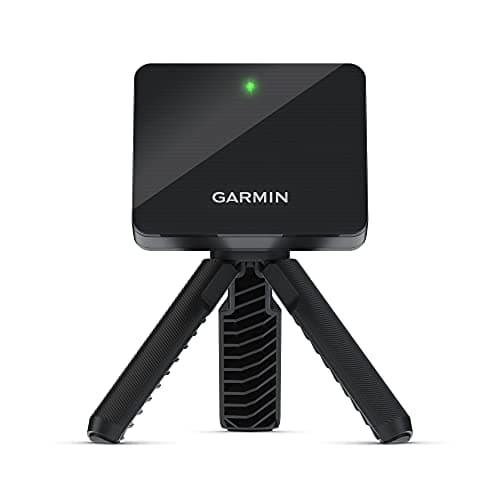
For most golfers the best portable launch monitor is the Garmin Approach R10, and the reason sits right in the word “portable”: a monitor earns its keep by being the one you actually carry to the range, and the R10 pairs genuine grab-and-go portability with the widest useful data set for the money and, crucially, a free app for its core numbers. This is a roundup of pocketable, battery-powered units you take to the range or set up in the back garden — not a fixed, ceiling-mounted home simulator. If a permanent room is what you want, that’s a different build; the units here go where you go.
How we ranked these
Portable monitors get sold on spec-sheet parameter counts, but the things that decide whether one earns a place in your bag are more practical. We ranked on four questions, in this order:
- How portable is it, and how fast does it set up?The whole category exists to be carried, so a unit that goes from bag to first shot in under a minute — battery-powered, no fuss — beats a fiddlier one you leave at home. This is the criterion the others are weighed against.
- How much trustworthy data does it give for the money?Not raw parameter count — useful, reliable numbers. Ball speed, club speed, launch and honest carry are what an improving golfer acts on; measured spin and video are a step up you pay for. We valued the data you can trust over the longest list.
- What does it cost to run?The sticker is only half the price on several of these. A yearly subscription for full data or a simulator is a recurring cost most reviews leave off, so we weighed it heavily — a fee-free unit keeps winning every year you don’t pay one.
- Does it double as a simulator?Some of these are practice tools only; some can drive home course play. That’s a genuine tiebreaker if playing at home is part of your plan — but it’s last on the list, because a portable unit’s sim is never a fixed room’s.
We did not rank on brand prestige or the biggest number on the box, and we did not lab-test anything — we compiled the manufacturers’ published specifications and how each unit captures a shot, and every source is listed at the foot of the page.
Here is how the five stack up on the things that actually decide a portable purchase, before we get into each one.
| Monitor | Reads the shot | Subscription | Doubles as a sim? | Best for |
|---|
| Garmin Approach R10 | Radar (estimates spin) | Free core data; paid home sim | Yes, on a paid tier | The best all-round portable |
| Rapsodo MLM2PRO | Camera + radar (measures spin, video) | Full data & sim behind a membership | Yes | Measured spin and shot video |
| FlightScope Mevo | Radar, 18 parameters (ball sticker) | No fee for core data; paid E6 content | Some E6 courses included | Pro-lineage range data |
| PRGR HS 130-A | Radar, speed only | None | No | Cheap, pocketable speed training |
| Voice Caddie SC4 Pro | Radar, standalone screen | None | Basic sim bundled | Self-contained, no-phone practice |
1. Garmin Approach R10 — the best all-round portable
The R10 wins because it does the portable job with the fewest compromises. It’s a small, battery-powered doppler radar that tripod-mounts and sets up in about a minute, and its core launch data — ball speed, club speed, launch, estimated carry — runs on the freetier of the Garmin Golf app, so the sticker price is close to the whole price. That combination of true portability, a genuinely useful data set and no mandatory fee is why it’s the unit we point most golfers toward first, and why it tops our under-$1,000 rounduptoo. The honest limits: radar estimates spin rather than measuring it, there’s no shot video, and the at-home simulator (Home Tee Hero) is a paid tier. For a portable practice monitor with a path to home sim, though, it’s the sensible default — the full case is in our R10 review.
2. Rapsodo MLM2PRO — the portable that measures spin
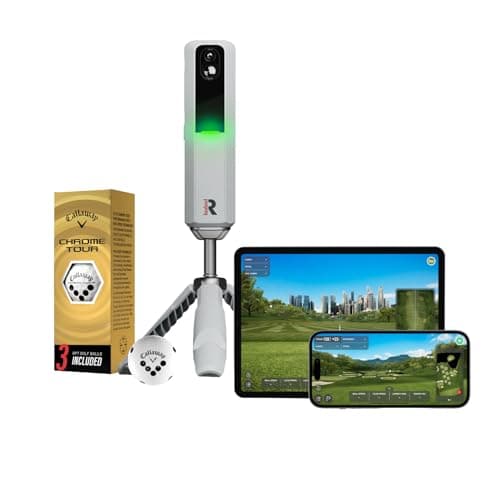
If you want more than estimated numbers, the MLM2PRO is the step up. It pairs a camera with radar, so it measuresball spin from the markings on the ball rather than modeling it, and it records video of each swing you can replay. It’s still portable — it goes to the range — and it doubles as a simulator front-end for home course play. The catch, and the reason it ranks second rather than first, is the subscription: its full data set and simulator sit behind a paid membership, so budget the box plusa yearly fee, and give the camera decent light and careful alignment. For a golfer who wants measured spin and video in a portable unit and will pay to keep them, it’s the richer tool — see the full review.
3. FlightScope Mevo — the pro-lineage pocket radar
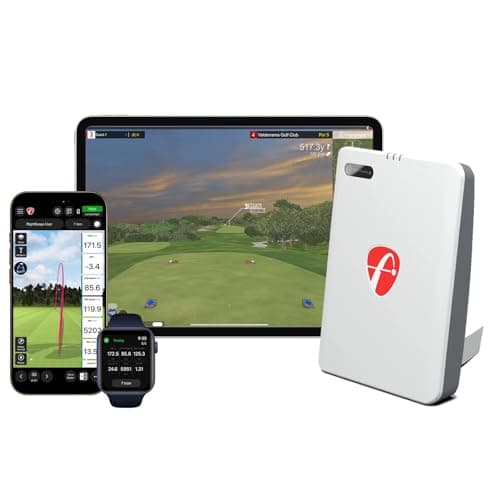
The Mevo brings a serious launch-monitor pedigree to a pocket radar: FlightScope builds the professional units used by coaches and tour players, and the Mevo carries that radar lineage in a battery-powered box. The listing quotes 18 data parameters — plenty for a full practice session — and it ships with a handful of E6 simulator courses. It ranks here rather than higher because of two frictions: it needs a small metallic sticker on the ball for full data (fiddly, and a consumable), and the wider simulator experience still points you toward paid E6 content. As a radar it estimates spin rather than measuring it. For a practicer who values the FlightScope name and the parameter depth and doesn’t mind the sticker, it’s a lot of radar for the money — the Mevo review covers it in full.
4. PRGR HS 130-A — the pocket speed monitor
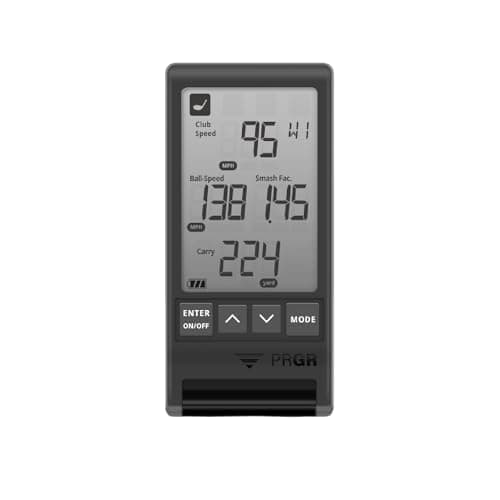
The PRGR is the most portable unit here by a distance — it’s the size and weight to live permanently in the bag — and it’s the purest no-strings option: no app, no account, no subscription, ever. It shows ball speed, club speed, smash factor and an estimated distance on its own little LCD the instant you swing, and it even reads clubhead speed without a ball, which makes it a genuine speed-training companion. It ranks fourth not because it does its job badly but because that job is narrow: it reads speed metrics only— no launch angle, no spin, no carry mapping, no simulator. If speed and smash factor are all you want, though, nothing here is cheaper or more grab-and-go, and its running cost is a set of AAA batteries. Full detail in the PRGR review.
5. Voice Caddie SC4 Pro — the self-contained all-in-one
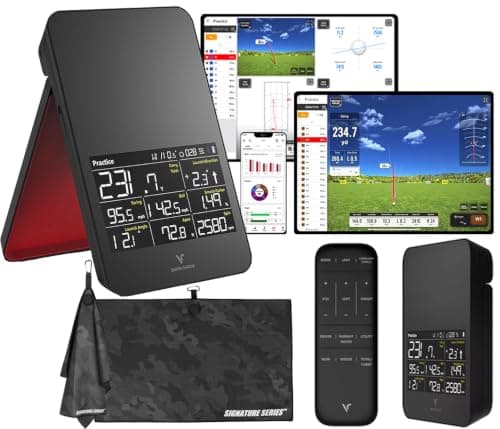
The SC4 Pro is the pick for the golfer who wants portable numbers without a phone in the loop. It’s a standalone doppler monitor with its own built-in display, so you read your carry and speed off the unit itself — no pairing, no app account, no subscription — and it’s sold as a monitor-and-simulator bundle, so a basic home-sim function is included. It ranks fifth here on the breadth of independent feedback rather than on any flaw: it’s less widely reviewed than the Garmin and Rapsodo, and as a radar it models spin rather than measuring it. But for a range-practice improver who wants a tidy, self-contained unit with nothing to log into, it’s a genuinely appealing option — the SC4 Pro review makes the case in full.
Skip this: expecting fixed-sim accuracy or full club data from a pocket unit
The mistake that wrecks expectations is buying a portable unit and judging it as if it were a ceiling-mounted launch monitor in a fitting bay. A pocket radar or a self-contained personal unit is a superb practice and speed tool, but it’s not a five-figure fixed system, and it won’t hand you lab-grade every-parameter club data — face angle, club path, precise measured spin on every shot — with the accuracy a permanent overhead array gives. Manage the expectation by price class: the more you pay in this field, the more measured (rather than estimated) data you get, but even the best unit here is a portable tool making portable trade-offs. Buy one to make your practice honest and your carry distances real; don’t buy one expecting the numbers on a tour truck. If full fixed-sim fidelity is the goal, that’s a room build, not a pocket unit.
Portable unit vs a fixed home simulator
The first fork is what you actually want. A portable monitor goes to the range, sets up in a minute, and reads your shot outdoors or into a net; a fixed simulator is a permanent room — a mounted or floor unit, a laptop, a projector and an impact screen — built to play courses in high fidelity. The portable units here can all read a shot into a net, and some can drive a modest home sim, but none replaces a dedicated room. The honest way to decide is to ask whether your priority is practice anywhere or play at home. If it’s practice, a portable unit is the whole answer; if it’s immersive course play, price a full build in our cost-of-ownership breakdown before you buy the monitor.
Which numbers a portable unit gives reliably — and which it guesses
Not all data on the screen is equal. Portable units — radar ones especially — read ball speed, club speed, launch and carry reliably enough to practice and self-fit against; those are the numbers to act on. Spinis the one to treat with care: on a pure radar it’s estimated from ball flight, so read it as a trend, not gospel. The exception is a camera unit like the Rapsodo, which measures spin optically from the ball. Our launch-monitor data guidetranslates every metric and tells you which few actually move your game — the short version is to trust your carry number and be skeptical of a radar’s exact spin figure.
The subscription trap
The recurring fee is the cost nobody quotes you, and it’s the single biggest thing that separates the sticker price from the real one. Some of these units keep their best data or their simulator behind a yearly membership; over three seasons that fee can quietly add up to a meaningful fraction of a second monitor. It’s not automatically a rip-off — a subscription can fund real, updated course content you actually play — but you should choose it on purpose, not discover it on a renewal email. If you only want practice data, a fee-free unit like the PRGR or the free-app R10 gives you everything you’ll use; our no-subscription roundup filters the field to units that never send a renewal notice.
Battery and phone dependency
A portable unit lives and dies by two things a fixed sim never worries about: its battery and, often, your phone. Radar units like the R10 and Mevo pair with a phone or tablet, so your session depends on that device’s battery and a stable Bluetooth link; the PRGR and the Voice Caddie sidestep this with their own on-unit displays, which is a real advantage in cold hands or a dead-signal range. Whatever you choose, charge the monitor before you go and, for a phone-based unit, keep the tablet topped up too — the most accurate monitor in the world is useless at 2% battery. This dependency is a fair reason a self-contained unit appeals to a golfer who just wants to switch on and swing.