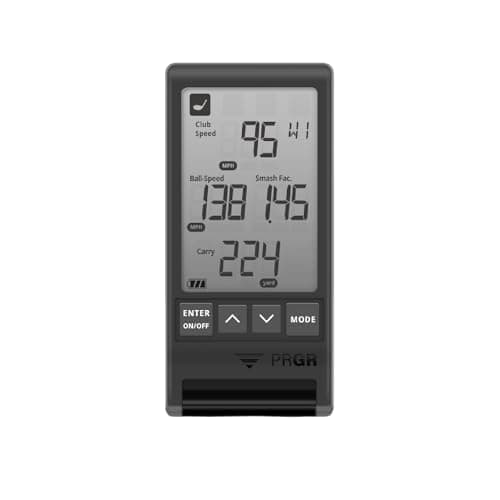
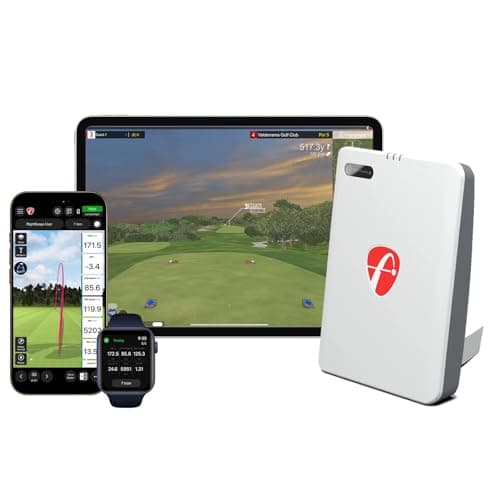
These two portable radars sit at opposite ends of the same category, so the decision is refreshingly clear once you name what you want from a session. The FlightScope Mevois a full ball-flight doppler from a serious launch-monitor lineage — carry, ball speed, spin, launch, height and more, a listed 18 data parameters in all. The PRGR HS 130-A is a tiny speed-and-carry pocket unit that reads ball speed, club speed, smash factor and an estimated distance on its own screen, with no app and no subscription. Check the live prices above first, because the PRGR costs a fraction of the Mevo, and that gap is the heart of the choice.
At a glance
| | FlightScope Mevo | PRGR HS 130-A |
|---|
| What it reads | Full ball flight — a listed 18 parameters (carry, ball speed, launch, spin, height and more) | Speed only — ball speed, club speed, smash factor, estimated distance |
| How it reads it | Doppler radar, with a metallic sticker on the ball for full data | Doppler radar, nothing on the ball |
| Where you read it | A paired phone or tablet app | Its own on-unit LCD, no phone |
| Running cost | No fee for core data; stickers are a consumable; deeper sim points to paid E6 content | A set of AAA batteries — nothing else |
| Home simulator | Ships with some E6 courses | None — it’s a speed trainer |
| Best for | A data-hungry improver who wants the full launch picture | Cheap, portable speed and smash training |
Choose the FlightScope Mevo if…
You want the whole ball-flight picture, not just speed. The Mevo reads the deep data set a coach would look at — the listing quotes 18 parameters, spanning carry, launch, spin and more — so you can diagnose why a shot flew the way it did rather than only how fast it left the face. It comes from FlightScope, whose radar technology sits inside far pricier professional units, and it ships with a handful of E6 simulator courses so you can dabble in home play. It’s still portable and battery-powered — a grab-and-go radar at heart. The trade you accept: it needs a small metallic sticker on the ball for full data (fiddly, and a consumable you replace over time), as a radar it estimatesspin rather than measuring it optically, and the wider simulator experience points you toward paid E6 content. For a data-hungry improver who wants trustworthy range numbers from a name that knows radar, it’s a lot of monitor for the money — the full case is in our Mevo review.
Choose the PRGR HS 130-A if…
You want swing and ball speed cheaply and portably, and not much else. If your practice is speed training — chasing clubhead speed, checking ball speed and smash factor, confirming an overspeed protocol is actually adding miles per hour — the PRGR gives you the number the instant you swing, off its own LCD, with no phone and no fee. It’s the most pocketable unit in the category, cheap enough to live in the bag permanently, and it reads clubhead speed even without a ball. Its running cost is a set of AAA batteries. The honest limit is that it’s speed metrics only— no launch angle, no spin, no carry mapping, no simulator, and only a short on-device shot log. That narrowness is the point: it does the speed job for a fraction of the Mevo’s price and none of the faff. Full detail in our PRGR review.
How they differ
Three things separate them, and none is about one being “better” — they’re built for different jobs. First, data depth: the Mevo reads a full ball-flight data set including carry, launch and an estimated spin figure; the PRGR reads speed, smash and an estimated distance, and stops there. If you want to know your real carry per club or work on launch and spin, only the Mevo can tell you; if you only want speed, the Mevo’s extra parameters are a list you won’t use. Second, workflow: the Mevo needs a ball sticker for full data and pairs with a phone or tablet, while the PRGR needs nothing but a fresh set of batteries and reads off its own screen — pick the friction you mind less. Third, and most concrete, price: these two aren’t priced alike, and the PRGR costs a fraction of the Mevo, so weigh the live numbers above against how much data you’ll genuinely act on. Neither is a five-figure professional unit, and we don’t run a test lab — this is drawn from published specs and how each device captures a shot.
A note on accuracy
Neither of these is a five-figure fixed system, so set expectations by what each is for. The Mevo carries FlightScope’s radar lineage and reads a broad data set, but as a radar it estimatesspin from ball flight rather than measuring it optically — treat the spin figure as a trend, not a lab number, and lean on its carry, launch and speed readings, which are the ones you’ll actually club with. The PRGR has a strong reputation for the narrow job it does: independent side-by-side reviews have reported its ball-speed tracking close to far pricier units, which is a big part of why speed-focused golfers rate it. Its distance figure, like any radar’s, is estimated rather than measured. We base all of this on published specifications and how doppler radar captures a shot — we don’t run a testing lab and don’t pretend to.
The workflow, in practice
Spec sheets don’t capture how different these two feel to actually use, and that difference matters more than a parameter count. With the Mevo you set up a phone or tablet, position the unit behind the ball, and — for full data — peel a small metallic sticker onto the ball and keep it aligned; it’s a mild ritual that’s no bother for a dedicated hour of practice but real friction for a two-minute check. With the PRGR you take it out of the bag, point it down the line, and swing; the number is on the screen before you’ve finished your follow-through, and there’s nothing to pair, mount, stick or charge beyond a AAA cell. So the honest question isn’t only “how much data do I want” but “how much setup will I tolerate before I stop bothering” — because the monitor you actually pull out is the one that helps, and for some golfers the Mevo’s richer data is worth the ritual while for others the PRGR’s zero-friction speed check wins precisely because they’ll reach for it every time.
Which one improves your game faster?
The better tool is the one that fixes your actual fault. If your scores are held back by distance and gapping— you don’t know your real carries, you come up short on approaches, your long game is a guess — the Mevo is the one that changes that, because knowing your true carry per club and seeing your launch is how you stop leaving approach shots in the front bunker. If your game is held back by clubhead speedand you want a number to chase through a speed-training block, the PRGR gives you that feedback instantly and cheaply, session after session, with nothing to set up. Plenty of improving golfers genuinely need the first; plenty of longer hitters working on speed need the second. Name your fault, and the monitor picks itself — and if you’re not sure which fault is costing you most, our launch-monitor data explained guide helps you read the numbers that tell you.
Can you own both?
It’s a more common answer than you’d think, because the two barely overlap. A lot of committed practicers keep a full-data monitor for real sessions — mapping carries, checking launch, playing the odd E6 course — and let a pocket speed unit live permanently in the bag for a quick speed check on any range, anywhere, without unpacking the bigger unit. At the Mevo and PRGR’s very different prices that’s not an extravagant pairing, and it covers both jobs properly rather than asking one device to do both badly. If a single purchase has to cover everything, though, buy for your main fault first and add the other later — and if the budget is the real constraint, see where each lands in our under-$1,000 roundup.
Skip the decision entirely if…
Neither is the right answer if what you actually want is measured spin and shot video. Both of these are pure radars — the Mevo estimates spin and the PRGR doesn’t read it at all — so if optically measured spin and a swing replay are what you’re after, a camera unit like the Rapsodo MLM2PRO is the tool, at the cost of its subscription. And if you want the full launch picture on a free apprather than the Mevo’s sticker-and-parameter approach, the Garmin R10 is worth a look — a full-data radar whose core numbers cost nothing to run. Our PRGR vs Garmin R10comparison covers that speed-vs-full-data decision against the free-app radar, and if the numbers themselves are what’s confusing you, our launch-monitor data explained guide translates every metric before you spend.