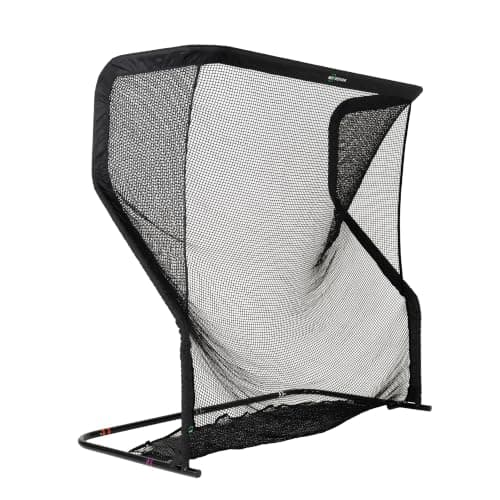
For a garage bay you intend to keep: a published 7 ft wide by 7 ft high by 3 ft 6 in deep footprint, a patented ball return so you never walk into a confined space to collect, a 225 mph netting rating and a three-year warranty.
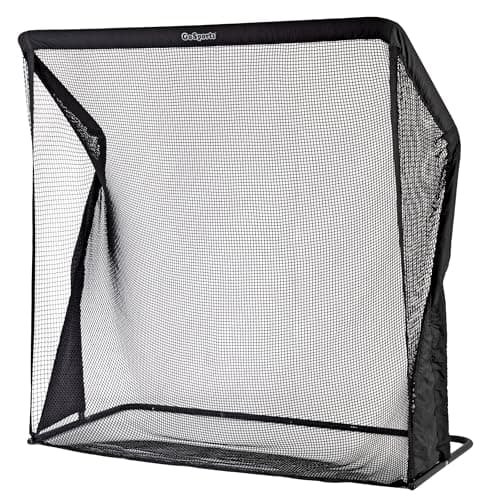
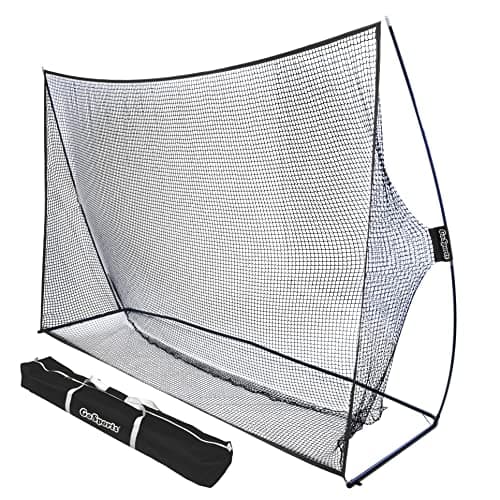
The verdict: the Net Return Home Seriesis the net to buy for a garage. Its published footprint — 7 ft wide, 7 ft high, 3 ft 6 in deep — is the one on this page that fits a normal bay without rearranging the room, the patented S-shape return rolls the ball back to your feet so you are not walking into a confined space after every shot, and the 225 mph netting rating is the only published rating here above 200. Budget pick: the GoSports 10 ft x 7 ft net, which costs a small fraction of it and catches a ball just as safely — the catch is the number in its name, because a 10 ft face is wider than most single bays will give you. Prices are live from our price layer, stamped November 22, 2026.
This page exists because the general net roundup answers a different question. Our best golf practice netspage ranks the field on netting strength, ball return and warranty, and its winner is the widest cheap net — which is the right answer on a lawn and the wrong one in a garage, where width is the constraint rather than the feature. So this page ranks the same six products on the three published numbers a garage actually decides on: width, height and depth.
Measure three things before you read any further
Not the net. The room. Write down three numbers and compare them to the published dimensions in the table above, because every disappointed garage-net buyer we have read about got one of these wrong:
- 1. Usable ceiling height, measured under the lowest obstruction.Not the apex — the garage door track, the opener motor, a light fitting, a joist. Your swing arc needs clearance above the net’s own published height, and the published height is the floor of what you need, not the total. A 7 ft net in a bay whose lowest obstruction is 7 ft is a net you cannot swing at.
- 2. Clear width at the hitting position.Measure between whatever actually narrows the bay — a car, a bench, a water heater, shelving. This is the number that rules nets in and out fastest, and it is why the two 10 ft faces on this page sit at the bottom of it rather than the top.
- 3. Depth from the ball to the net, plus the net’s own depth. A net that is 3 ft 6 in deep eats three and a half feet of floor before you have stood anywhere. If you also want a launch monitor in the bay, a doppler radar has published minimum distances behind the ball and to the target; measure for the monitor at the same time, or you will buy the net twice. The build in full is in what a home setup costs.
Why the ball return matters more indoors than out
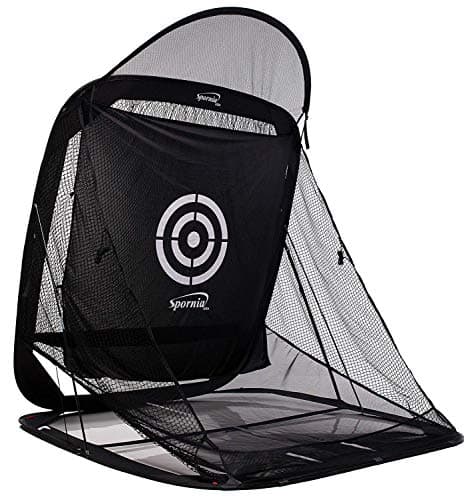
On a lawn, walking out to collect balls is mildly annoying. In a garage it is the thing that ends the session, because the floor between you and the net is where the balls stop and there is nowhere for them to go. Two nets here publish a genuine return mechanism: the Net Return’s patented S-shape, which its maker says absorbs impact and rolls the ball back to your feet, and the Spornia SPG-7’s auto-return ramp. Those are the two that turn a backstop into a practice station you can actually use for twenty minutes.
The GoSports standard net lists an “innovative golf ball return feature” and publishes no description of how it works or how far the ball travels, so we are not counting it as one. The Gagalileo cage has no mechanism and does not need one: it is a cube, so the ball drops at your feet by gravity. The Callaway Base net and the GoSports Elite have no return at all.
The one to skip indoors
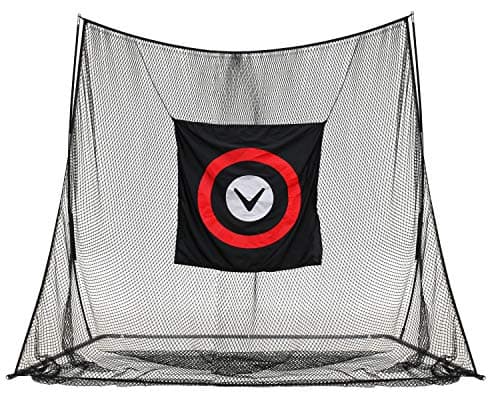
The Callaway Base Hitting Net, and this is a recommendation against a good product rather than a bad one. Its published footprint is 10 ft wide by 8 ft high by 3.5 ft deep, with a fiberglass frame, a stainless base and ground stakes, and a documented 190 mph netting rating. All of that is genuinely excellent — on a lawn. In a garage the 8 ft height is the problem rather than a feature, the ground stakes have nothing to go into, and the 10 ft width will not fit a bay that a car also uses. Buy it for the back yard; buy something else for the garage.
If a shank is your bad miss, buy the cube
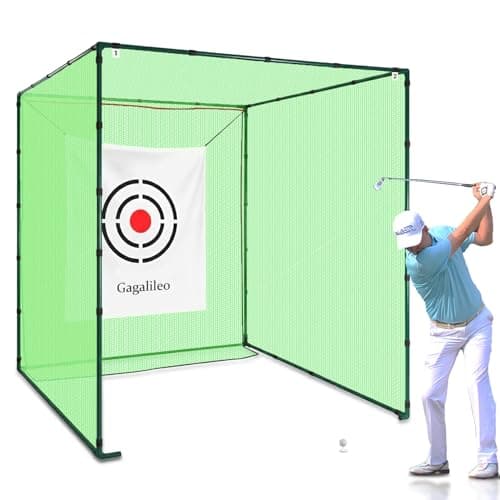
Every flat net on this page catches a ball that goes roughly where you aimed. None of them catches a genuine shank, because a shank leaves at close to ninety degrees and a flat net has no sides. The Gagalileo 8 ft x 8 ft x 8 ft cageis the only pick here that contains one, and in a garage that is not a luxury — the thing behind the net is a wall, a window or a car. Two honest caveats: the maker publishes no frame wall thickness, no netting denier and no rated ball speed that we could read, so you are buying on the dimensions; and an eight-foot cube needs eight feet of clear height plus swing arc, which rules it out of a lot of bays before price enters the conversation.
If the cage will not fit and your miss is genuinely sideways, the honest answer is a side barrier or a different practice plan rather than a bigger net. Putting and short-game work needs no net at all — best golf putting mats and how to practice golf at home cover what you can do in a bay too small to swing a driver in.
The mat is not optional
One thing a garage adds that a lawn does not: a concrete floor. Hitting a ball off concrete will wreck a wedge sole and your wrists in short order, so the mat is part of the purchase rather than an upgrade to it. A thin tri-turf pad is enough to start with, a thicker residential mat is the one you keep, and the field is ranked in best golf hitting mats with the cheap end in best golf hitting mats under $100.
The arithmetic: cost per square foot of protection
A net has exactly one job — stop the ball — and every net on this page does it. So the money is not buying safety, it is buying three other things: the footprint that fits your room, the return mechanism that keeps you hitting, and the frame that survives being hit for years. Price them separately and the ranking above stops looking strange.
The frame is the part that actually fails. The budget end of this category uses a fiberglass bow that flexes, and flexing is what eventually snaps it; the GoSports Elite exists specifically because of that, with a powder-coated steel frame and a published rating of over 10,000 hits, and the Net Return uses a 26 lb aluminum frame with a three-year warranty. If you have already broken one net, the frame is the spec to buy on and the cheapest net on the page is a false economy. If you have never owned one, buy the cheap net, find out whether you practice twice a week, and step up once you know the answer.
What a published ball-speed rating does and does not tell you
Three nets here publish a rating: the Net Return at 225 mph, the Callaway Base at 190 mph, and the GoSports Elite at over 10,000 hits at any swing speed rather than a speed figure. The other three publish nothing comparable. A rating is useful because it is a number the maker will stand behind — but it is worth keeping in proportion: published driver ball-speed averages sit around 171 mph on the PGA Tour and around 131 to 147 mph for amateurs, so a 190 mph net is already clear of any human swing. The rating is reassurance about longevity, not about whether the net will contain your drive.
What a rating does not tell you is what happens when you miss the net entirely, which is the real indoor risk. That is a geometry problem, and the only products that solve it are an enclosure or a side barrier.
Warranty is the spec nobody reads and everybody should
The spread here is wide and it tracks the frame rather than the price. The Net Return publishes three years. Both GoSports nets carry six months, including the expensive steel-framed one — which is a genuine mark against the Elite given what it costs. A net in a garage gets hit far more often than a net on a lawn, because it is available in February and in the rain, so the warranty is a live concern rather than paperwork.
Why we do not print the price in the text
Every number on this page comes from the live Amazon listing through our price layer at the moment the page is served, behind a 48-hour freshness gate, stamped with the date above. Nets are discounted heavily and unpredictably, and the order of these six by price moves with them — which is exactly why this page is ranked on published dimensions, which do not change, rather than on a price order that would be wrong next month. The only figures typed into the prose above are dimensions, ratings and warranty terms the makers themselves publish, each cited at the foot of the page.